


You need to look at time-to-finality and throughput (TPS). For finality, zkRollups like Starknet and zkSync offer near-instant settlement, while Optimistic Rollups have a multi-day delay. In raw TPS, networks like Polygon claim some of the highest figures. You must balance this speed with security and cost for your needs. Finding your optimal layer will become clearer as you explore these key trade-offs.
Table of Contents
Brief Overview
- zkRollups offer near-instant transaction finality, typically within seconds.
- Validiums also achieve high speed by keeping transaction data off-chain.
- Optimistic rollups have faster throughput but delayed finality due to challenge periods.
- Transaction speed depends on finality time and throughput metrics together.
- The fastest solutions often trade some data availability assurances for higher speed.
How to Measure Layer 2 Speed: The Two Key Metrics
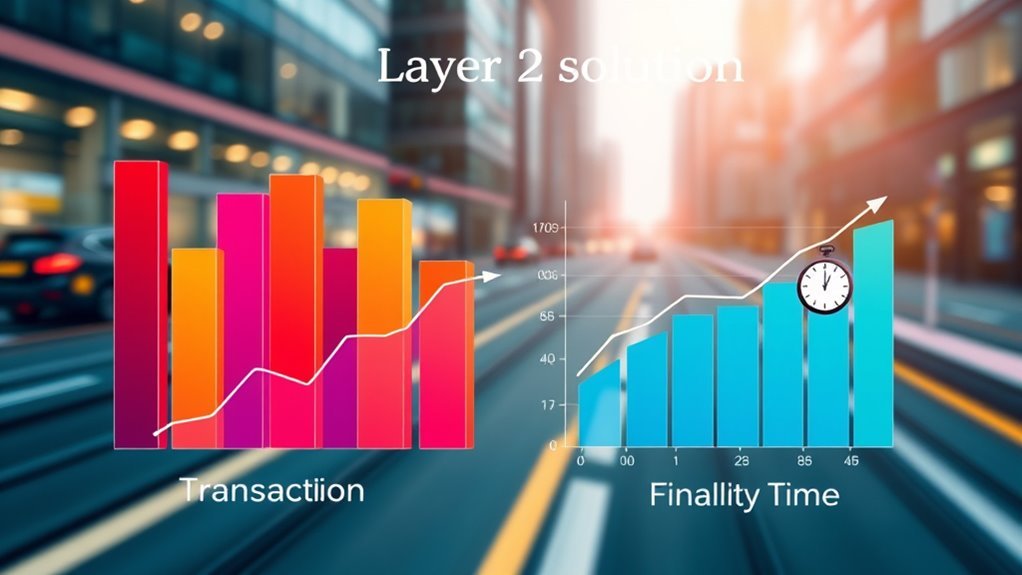
While you might assume transaction speed is a single number, it’s actually defined by two distinct technical metrics: transaction finality and transaction throughput. Transaction finality tells you when a transaction is irreversible and secure, directly impacting your safety. Transaction throughput measures how many transactions the network can process per second, which affects your user experience. Together, these core performance metrics give you a complete picture of a Layer 2’s operational speed and reliability. You can’t accurately assess a network by looking at just one; you need to understand both to judge its real-world capability and the transaction latency you might encounter. Additionally, solutions like zk-SNARKs for validation are crucial in enhancing both speed and security in Layer 2 networks.
Ranking the Fastest Layer 2 by Time-to-Finality
If you’re managing a high-frequency trading strategy or settling a large NFT sale, the moment a transaction becomes irreversible is your critical metric. This finality can vary widely across systems, making Layer 2 comparisons essential for security-focused users. Validium-based systems and certain zkRollups offer near-instant finality on their own chain—often in seconds—as a validity proof confirms your transaction immediately. Optimistic rollups enforce a lengthy challenge period, delaying finality for days. The ultimate security comes from Ethereum mainnet confirmation, which adds minutes. You must understand these finality implications; a system’s speed is meaningless if its state isn’t securely settled. For absolute safety, your benchmark should be L2 finality plus Ethereum’s checkpoint. Additionally, economic incentives in PoS networks promote honest participation, which can further enhance the security of transactions processed on Layer 2 solutions.
Evaluating Real-World Layer 2 Throughput: TPS Benchmarks
Transaction speed, measured in transactions per second (TPS), provides a raw benchmark for a network’s processing capacity, but you’ll find these figures often don’t translate directly to the real-world experience. For safety and stability, you must scrutinize the Layer 2 architecture behind the peak TPS claim. Some networks advertise extremely high speeds under ideal, lab-like conditions, but sustained throughput optimization under variable, real-world loads is what matters for your applications. You should prioritize chains that demonstrate consistent, high throughput during network congestion, as this directly affects transaction reliability and cost predictability. Examining historical performance data, rather than theoretical maximums, gives you a more secure foundation for evaluating a solution’s true capacity. Additionally, understanding the scalability solutions like sharding and rollups can provide insight into how well a Layer 2 solution handles increased demand.
ZK Rollups: How zkEVMs Achieve Near-Instant Finality

Zero-knowledge Ethereum Virtual Machines (zkEVMs) let you execute transactions off-chain and then prove their validity to Ethereum’s mainnet, achieving finality in minutes instead of hours. This architecture provides a strong safety guarantee. You’re assured a transaction is correct the moment its validity proof is verified on-chain. You don’t face a multi-day challenge window, a core security benefit of these zk rollups. The speed of transaction finality depends on proof generation time, not network latency or block confirmations. Modern zk rollups optimize execution efficiency to create these cryptographic proofs rapidly. This design makes your funds programmatically secure as soon as the proof is accepted, offering predictable and near-instant settlement. Additionally, the implementation of Danksharding is expected to further enhance scalability and performance for zk rollups in the future.
Optimistic Rollups: The Speed and Security Trade-Off
Unlike zk rollups with near-instant finality, optimistic rollups operate on a principle of deferred trust. They assume your transactions are valid when they’re posted to Ethereum, only verifying them if a challenge arises. This design creates inherent security trade-offs; you rely on honest participants, called validators, to monitor the chain and submit fraud proofs during a fixed challenge window, typically seven days. Until that window closes, your funds aren’t considered fully secure on the base layer. This delay is the core compromise for these networks, granting optimistic rollups higher speed and lower cost than mainnet but withholding immediate, absolute safety. You gain efficiency in exchange for a period of conditional trust. Understanding 51% attack vulnerabilities is crucial for evaluating the overall security of these systems.
Can Hybrid Execution Models Boost TPS Further?
How, then, can Layer 2 networks push transaction throughput beyond today’s established rollup models? You look to hybrid execution, which combines optimistic and zero-knowledge proof mechanisms. This model lets you process most transactions optimistically for speed, while periodically generating a ZK-proof for the entire batch to guarantee state correctness. This approach maximizes transaction efficiency by minimizing the overhead of constant proof generation while eliminating the long withdrawal delays of pure optimistic rollups. You gain faster finality and stronger security assurances, making it a prudent path for scaling without compromising on safety. This architectural evolution directly boosts potential TPS by streamlining verification and reducing redundant computational work.
Beyond L2s: How Validiums and Layer 3 Networks Compare for Speed

While hybrid models refine execution within Layer 2, alternative scaling architectures like Validiums and dedicated Layer 3 networks pursue even greater speed by fundamentally altering data availability and transaction batching. Validiums achieve a core speed advantage by posting only validity proofs to Ethereum, keeping transaction data off chain. This massively reduces latency and cost. You construct specialized execution environments on Layer 3 networks to isolate and accelerate specific applications, like high-frequency trading. This architectural choice enables more aggressive off chain computation and finer-grained transaction batching. You trade some data availability assurances for raw throughput, a calculated risk when your application demands ultimate speed and you manage security through other means, like a reputable data availability committee. The Ethereum 20 upgrade, with its enhanced transaction throughput, showcases how advanced architectures can significantly improve performance metrics across various applications.
The Inevitable Compromise: How L2s Balance Speed, Cost, and Security
- Data Availability Reliance: Some systems post minimal data to Ethereum, relying on external committees for faster, cheaper state updates. You trade the base chain’s robust data availability for speed, accepting a new trust assumption. Additionally, the choice of consensus mechanism can significantly impact the efficiency and scalability of these Layer 2 solutions.
- Proving Time Delays: Zero-knowledge rollups add latency for proof generation before achieving cryptographic finality on L1. You wait for computational security.
- Decentralization vs. Speed: Highly centralized sequencers offer the fastest throughput but create a single point of failure, directly weakening censorship resistance and uptime guarantees for your transactions.
Optimizing Your Application for the Fastest Layer 2s
Selecting a high-throughput Layer 2 is only the first step; your application’s architecture must be tailored to that rollup’s specific proving mechanism and data pipeline to achieve its maximum potential speed. Effective Layer 2 optimization strategies begin with a transaction speed analysis of your app’s typical patterns. For zero-knowledge rollups, you’ll design compute-heavy operations to align with proving cycles. On optimistic rollups, you’ll batch non-urgent writes to minimize contestation delays. Always structure contract calls to minimize calldata or use blob storage introduced by Dencun. You must verify finality times and design your user experience around the L2’s specific security model, ensuring safety without sacrificing responsiveness. Additionally, embracing decentralized identity solutions can further streamline user interactions within your application.
The Future of Ethereum Scalability: Speed in the Surge Era

Since Ethereum’s Layer 2 rollups now consistently process more daily transactions than the mainnet, the network’s scalability roadmap has decisively entered its Surge phase—a long-term effort to scale to 100,000+ transactions per second without compromising decentralization. You can expect this era to systematically overcome historical scalability challenges. The primary strategy involves making Layer 2s even faster and cheaper by enhancing Ethereum’s base layer to support them.
- Full Danksharding: This will expand data storage from today’s 6 blobs to 64, massively increasing throughput and eliminating Layer 2 transaction bottlenecks.
- PeerDAS: A decentralized data availability sampling network will ensure this scaling remains secure and trust-minimized.
- L1 Execution Optimizations: Upgrades like Ethereum’s Verge, implementing Verkle trees, will accelerate state access for L2s, further boosting finality speed. Additionally, the transition to Proof-of-Stake is expected to enhance overall network efficiency, further supporting Layer 2 scalability efforts.
Frequently Asked Questions
Why Do L2 Speed Claims Often Seem Unrealistic?
You see unrealistic speed claims because teams highlight ideal lab conditions, not congested mainnet reality. Marketing tactics often oversell results, obscuring scalability challenges under peak loads you’d actually face.
Does Using a Popular L2 Slow It Down for Everyone?
You hit a traffic jam, so network congestion rises for all, degrading user experience and lifting transaction fees. Scaling solutions like rollups combat this, but a popular L2 can indeed slow down under heavy load.
Is Speed the Only Factor When Choosing an L2?
No, speed isn’t the only factor. You must weigh a layer 2’s cost efficiency, its layer security, the overall user experience, and the network decentralization to ensure a safe, balanced choice for your activities.
How Do L2S Handle Sudden Transaction Volume Spikes?
Consider an L2 like a multi-lane highway: transaction prioritization strategies create express lanes for higher fees, while congestion management techniques like surge pricing dynamically adjust throughput to handle your spike.
Will Future Ethereum Upgrades Make Layer 2s Obsolete?
No, Ethereum scalability upgrades won’t obsolete Layer 2s; you’ll see them evolve together. Blockchain evolution focuses on specialized execution layers while mainnet handles security and settlement, ensuring Layer 2 longevity is core to its future.
Summarizing
Pick the perfect partner for pace. For a fast, fluid, friction-free future, select a savvy and speedy Layer 2. Let this lively list light your way, linking you to low-latency landscapes. The thrilling throughput and trust these titans transmit transforms your tasks. Turn towards tomorrow’s tech and taste its tempo today—your transactions triumph.

