


No single “best” hour guarantees a cheap buy, but you can improve your timing. Focus on market structure, not random dips. Overlaps between U.S. and Asian trading sessions often bring peak liquidity, which can reduce slippage. Dollar-cost averaging removes the stress of guessing daily swings. To make sharper decisions, understanding key session rhythms and on-chain data is your next logical step.
Table of Contents
Brief Overview
- The US-Asia market overlap offers peak liquidity, potentially reducing slippage.
- Asian session openings often show consolidation, providing calmer entry periods.
- Avoid high volatility during major session overlaps like US market open.
- Monitor exchange flows and support levels to identify stable buying opportunities.
- Dollar-cost averaging automates purchases, removing the need for precise daily timing.
Does a “Best Time of Day” to Buy Ethereum Actually Exist?

Do market rhythms actually create a consistent daily pattern for buying Ethereum? Not in a reliable, predictive sense. While you might observe historical dips during specific hours, these aren’t consistent signals for executing a safe purchase. Market Trends are primarily driven by macroeconomic news and large institutional flows, which operate on a global, 24/7 schedule. Equally, Trading Psychology can create short-lived volatility—like sell-offs in one time zone—but this noise doesn’t constitute a strategic edge. Relying on such patterns is akin to timing the market, which increases your exposure to risk rather than managing it. For a safety-focused approach, you need a framework based on more substantive, less ephemeral factors than the clock. Additionally, considering robust security features can help you make more informed decisions in your trading strategy.
The Core Framework: Three Factors That Influence ETH Purchase Timing
Since daily price patterns lack a reliable signal, a more robust method for timing an ETH purchase examines three concrete factors: network activity, market structure, and protocol development. You anchor your decision in network fundamentals, like daily transaction volume on Layer 2s or gas fee trends, rather than reacting to ephemeral market sentiment. Analyzing market structure involves identifying key support levels and avoiding periods of extreme volatility driven by herd behavior. Finally, you monitor the protocol’s development roadmap, as successful upgrades like Danksharding implementation or Pectra can solidify Ethereum’s long-term utility. This framework helps you manage trading psychology by basing actions on verifiable data, not fleeting hype.
How U.S. and Asian Trading Sessions Drive Ethereum Price Action
| Session | Typical Action | Key Influence |
|---|---|---|
| Asian Markets Open | Consolidation/Build-up | Regional News & Sentiment |
| US-Asia Overlap | Peak Liquidity | Order Book Depth |
| US Session Close | Sentiment Resolution | Macro Market Sentiment |
Aligning your activity with session transitions lets you execute with clearer market sentiment and a fuller order book, potentially reducing slippage. Effective governance mechanisms can also influence trading behavior and market dynamics.
Identifying Periods of Typically Higher Ethereum Volatility
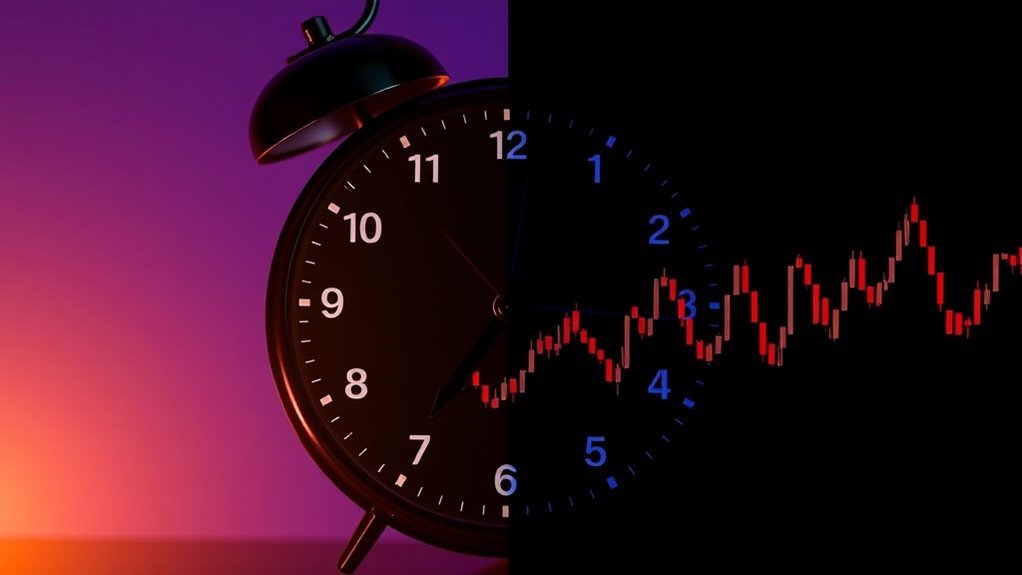
While Ethereum’s price movement might appear unpredictable, specific recurring periods consistently exhibit higher volatility. You’ll observe that volatility patterns often spike during the overlap of major market sessions, especially when U.S. markets open as Asian sessions are still active. This creates a convergence of liquidity and trading volume. Market sentiment during these windows reacts rapidly to macro news, frequently causing sharper price swings. You can monitor these periods to understand when larger moves are statistically more probable. Recognizing these cycles helps you plan safer entries by potentially avoiding the most turbulent, unpredictable price action. This analysis is purely observational, aiming to identify recurring market structure, not predict future prices. Additionally, Optimistic Rollups can significantly enhance Ethereum’s scalability, potentially impacting market dynamics during these volatile periods.
Timing Your Trade Around Scheduled Protocol Upgrades and Forks
4. Wait for Post-Upgrade Stability: Let the network finalize several epochs after the upgrade. This allows you to confirm chain stability and assess the genuine technical impact before executing a trade. Additionally, consider the improved transaction throughput capacity that can influence user behavior and market dynamics following upgrades.
Why Ethereum’s Finality Affects Trade Execution Confidence
Because a trade isn’t truly settled until the blockchain says it is, Ethereum’s economic finality is the critical factor determining when you can consider a transaction irreversible. Under Proof of Stake, finality isn’t instant; it occurs after a series of consecutive blocks, known as an epoch. This finality impact means you can’t have complete trade execution confidence until the network formally finalizes the block containing your transaction. Before finalization, there remains a small, non-zero risk of a chain reorganization that could invalidate your trade. For significant purchases, waiting for this state ensures the settlement is absolute, protecting you from the operational risk of a transaction being unwound after you assume ownership. Additionally, understanding validator selection and incentives can further enhance your confidence in the network’s integrity during your trading activities.
Dollar-Cost Averaging Versus Timing Your Ethereum Purchase

Two strategies dominate when acquiring Ethereum: actively timing market entries or systematically buying through dollar-cost averaging. Your choice depends on your risk tolerance and time commitment. You can attempt to buy dips based on market sentiment, but consistently predicting short-term price movements is notoriously difficult. A disciplined dollar-cost averaging strategy, where you purchase a fixed dollar amount at regular intervals, mitigates this risk by smoothing out your average entry price over time.
- Market Timing Relies on Sentiment: You’re betting you can interpret market sentiment to buy low, which requires constant monitoring and carries high emotional risk.
- DCA Automates Discipline: You remove emotion by scheduling fixed purchases, whether the price is up or down.
- Timing Seeks Maximum Gain: This approach aims for optimal entries but often results in missed opportunities or buying at peaks.
- DCA Prioritizes Risk Management: It forgoes perfect timing to build a position steadily, reducing the impact of volatility on your overall cost basis. Additionally, understanding consensus mechanisms can provide insights into the technological underpinnings of Ethereum, influencing your long-term investment strategy.
Assessing Liquidity Shifts Between Ethereum Mainnet and Layer 2s
Ethereum Mainnet’s role is shifting from transaction execution to a high-value settlement and data availability layer. For safe execution, you must now assess liquidity dynamics between it and Layer 2s. This involves tracking trading volume splits and performing order book analysis on both venues to gauge depth. Strong market correlations often exist, but liquidity can fragment, leading to increased price slippage on one chain if you place a large order without checking the other. You’re securing your entry by confirming where the deepest, most stable pools reside before trading, as capital migrates with fee changes post-Dencun. As Ethereum transitions to Proof of Stake, the efficiency of liquidity management becomes increasingly crucial for traders.
Essential Tools for Tracking Volatility, Exchange Flows, and Staking Data
To effectively time an Ethereum transaction or investment, you must first measure the market’s real-time conditions using a suite of specialized analytics tools. These platforms provide the objective data you need to manage risk, avoiding reliance on speculation. You can monitor key signals like exchange flows to gauge potential selling pressure and review staking metrics to assess network security and participant commitment.
- Volatility Tracking: Use charts with statistical indicators to measure expected price swings, helping you identify calmer entry periods.
- Exchange Flow Analysis: Track net deposits or withdrawals from exchanges to spot accumulation or distribution trends.
- Staking Dashboards: Monitor total staked ETH and validator queue health for insights into long-term holder conviction.
- Sentiment & Bot Aggregators: Review fear/greed indices and track trading bot activity to understand prevailing market psychology. Additionally, consider the evolving dynamics of staking rewards as they play a critical role in the long-term sustainability of the Ethereum network.
Synthesizing Market Structure, Events, and Strategy for Better Timing
Individual data points from tracking tools aren’t actionable until you integrate them into a broader view of the market. You must synthesize technical structure, scheduled network events, and a defined personal strategy. For instance, observe trading patterns to identify high-liquidity zones and support levels, which often provide more stable entry points. Simultaneously, align your analysis with calendar events like protocol upgrades or significant Layer 2 token unlocks, which can shift market sentiment. Your final timing decision should filter this synthesized view through your risk parameters and investment horizon, avoiding reactive trades. This disciplined approach prioritizes capital preservation over opportunistic gains. For deeper context on market mechanics, review our analysis of Ethereum’s blockchain architecture. Understanding the layered architecture can provide insights into market responsiveness during significant events.
Frequently Asked Questions
Does Ethereum’s Staking Yield Vary by Time of Day?
No, your staking rewards don’t vary by hour. They’re based on network activity over epochs. However, your *purchasing* power for ETH is affected by market volatility, which fluctuates throughout the trading day.
Do Layer 2 Transaction Fees Fluctuate at Predictable Daily Times?
Yes. You’ll observe predictable transaction cost trends on L2s like Arbitrum or Optimism that correspond to user activity patterns during peak and off-peak network hours in major time zones.
How Does the Ethereum Protocol’s Scheduled Burning Affect Buying Timing?
The burn operates like a steady faucet, not a daily switch. Its burning impact on ETH supply is predictable long-term, so it shouldn’t directly dictate your short-term buying strategy.
Are There Daily Patterns in Exchange Withdrawals to Self-Custody?
Yes, withdrawal trends to self-custody show clear daily patterns tied to global exchange activity. You’ll see higher volumes during peak trading hours in Asia, Europe, and the US as investors secure holdings.
Does Finality Time Differ Between Network Peak and Off-Peak Hours?
No, finality time remains consistent regardless of network congestion because it’s based on fixed 12.8-minute epochs. Your transaction speed can vary with load, but finality is secured by the protocol itself.
Summarizing
You’re not just catching a trade; you’re catching a wave, built by global markets and network pulses. Align your entry with these deep tides, not just the surface chop. See your timing as a lighthouse, using its disciplined beam to navigate volatility’s fog. In the end, your best moment is carved from a strategy as solid as the blockchain itself.

