


You need to understand a blockchain’s priorities to compare the best. Algorand excels with instant, final transactions under five seconds, while Ethereum provides a secure foundation for smart contracts. Cardano focuses on peer-reviewed upgrades and Avalanche allows custom, fast subnets. Polkadot enables cross-chain apps and Cosmos connects sovereign chains. Each balances speed, security, and decentralization differently. See which network aligns with your project’s specific demands ahead.
Table of Contents
Brief Overview
- Algorand’s pure proof-of-stake consensus achieves transaction finality in under five seconds, a notable speed advantage.
- Its design prioritizes safety through immediate finality, reducing reorganization risks compared to probabilistic chains.
- A potential trade-off exists between Algorand’s high performance and more centralized validator selection for block proposal.
- Unlike Solana’s speed-focused model, Algorand emphasizes consistent reliability and true finality over peak throughput.
- It differs from Polkadot’s shared security, operating as a single, high-integrity chain rather than a multi-chain ecosystem.
Why Proof of Stake Is the Dominant Consensus Model?

While Bitcoin’s Proof of Work established the foundational security model, Proof of Stake has become the dominant consensus mechanism for scalable, programmable blockchains because it directly addresses three critical constraints: energy consumption, capital efficiency, and finality speed. You’re no longer securing the chain with immense physical computation but with staked capital, which slashes energy use by over 99%. This model creates powerful validator incentives aligned with honest participation, as malicious acts can lead to the slashing of their staked funds. Your stake isn’t locked in unproductive hardware; it’s actively securing the network while potentially earning yield. The architecture provides faster, more predictable finality, reducing the window for chain reorganizations and directly bolstering long-term network security for all participants. Additionally, the transition to Proof-of-Stake has encouraged miners to explore new strategies, enhancing the overall resilience of the blockchain ecosystem.
Criteria for Evaluating Proof of Stake Networks
Since a Proof of Stake network’s viability depends on its architecture, you need to evaluate it through a clear technical framework. Your primary focus should be on network security, which is fundamentally driven by robust cryptography and the economic design of validator incentives. You must examine the cost to attack the chain relative to the value it secures. Analyze how the protocol penalizes malicious validators through slashing mechanisms and whether honest participation is reliably profitable. The distribution of stake matters; excessive concentration can undermine decentralization and safety. You’re assessing a system where financial penalties and rewards directly enforce honest behavior, creating a secure and stable operational foundation for all participants. Additionally, consider how the transition to Proof of Stake has transformed network dynamics and security protocols.
Ethereum’s Proof of Stake Foundation for Smart Contracts
- Settlement Assurance: The PoS validator set provides high-assurance finality for transactions, securing all state changes for L2s and smart contracts. This mechanism reduces the risk of double-spending and fraud, enhancing transaction integrity across the network.
- Decentralized Security: A globally distributed validator network mitigates single-point-of-failure risks for the ecosystem’s core logic.
- Scalability Design: Proto-danksharding and rollups scale throughput without compromising the security guarantees of the foundational layer.
Algorand’s Pure Proof of Stake for Speed and Finality

Algorand implements a unique consensus protocol, Pure Proof of Stake, where speed and immediate finality are non-negotiable design pillars. You get fast, irreversible transaction settlement. Algorand performance metrics demonstrate this, achieving block times under five seconds with true finality, not probabilistic confirmation. This protocol’s cryptographic sortition randomly selects validators for each round, providing robust Byzantine agreement and predictable security for your assets. The Algorand governance model complements this by formally managing protocol upgrades through transparent stakeholder votes, ensuring controlled evolution of the network’s core parameters. This integrated design prioritizes operational stability, giving you a predictable environment where transactions can’t be reversed, eliminating fork-based risks that threaten your holdings.
Cardano’s Research-First Proof of Stake for Scalable Contracts
- Peer-Reviewed Foundation: Every protocol upgrade undergoes academic scrutiny, aiming to eliminate vulnerabilities before implementation.
- Layered Settlement: The Cardano Settlement Layer (CSL) handles ADA transfers, while the Cardano Computation Layer (CCL) runs smart contracts, isolating complexity.
- Epoch-Based Security: The Ouroboros protocol operates in epochs and slots, using a provably secure leader election process to maintain network integrity.
Solana’s High-Throughput Proof of Stake for DeFi and NFTs
While other blockchains prioritize decentralization, Solana’s Proof of Stake architecture is engineered for raw speed, using innovations like proof-of-history to sequence transactions before they reach consensus. You benefit from this high-throughput design, which delivers the low and predictable transaction costs essential for vibrant DeFi applications and a high-volume NFT market. However, you must weigh this against Solana’s historical network stability challenges. The system’s Solana scalability demands expensive, high-performance hardware, which concentrates validator incentives around well-capitalized operators. This trade-off is central to its model. You get a powerful engine for high-frequency use cases, but the operational demands and past outages require your careful consideration regarding long-term network resilience and security. Additionally, Optimistic Rollups are emerging as a promising solution to enhance scalability across various blockchain ecosystems.
Avalanche’s Proof of Stake Subnets With Rapid Finality

- Application-Specific Subnets: You can deploy custom Avalanche subnets, which are sovereign blockchains with their own rules and validators, isolating operational risk.
- Primary Network Security: Each subnet is validated by a dynamic subset of the highly-staked, permissionless Primary Network, inheriting its robust security.
- Predictable Performance: Subnets operate in parallel, preventing congestion on one from impacting another, ensuring reliable throughput and consistent rapid finality.
Polkadot’s Proof of Stake for Cross-Chain Interoperability
Polkadot’s architecture tackles interoperability by design, moving beyond isolated chains like Avalanche’s subnets. You can’t just rely on bridges for secure communication; Polkadot’s relay chain provides a shared security layer. This creates a safer environment for parachains to exchange data and assets, directly addressing interoperability challenges. Its nominated proof-of-stake consensus secures this entire network, ensuring validators you elect are accountable for cross-chain capabilities. Additionally, its shared security model enhances the overall reliability of transactions across the network.
| Mechanism | Safety Benefit |
|---|---|
| Shared Security Model | Parachains inherit the relay chain’s robust consensus |
| Cross-Chain Message Passing | Trustless, verified communication between parachains |
| Nominated Proof-of-Stake | Elected validators provide collective chain security |
Cosmos’ Proof of Stake and the Internet of Blockchains
- Sovereign Security: Each app-chain runs its own Proof-of-Stake consensus, allowing you to control validator sets and governance parameters directly.
- Trust-Minimized Bridges: IBC facilitates secure, permissionless transfers by using light clients to cryptographically verify state proofs from other chains.
- Hub-and-Zone Model: The Cosmos Hub acts as a primary router, enhancing security by coordinating communication between independent zones.
Comparative Analysis: Transaction Speed, Finality, and Decentralization
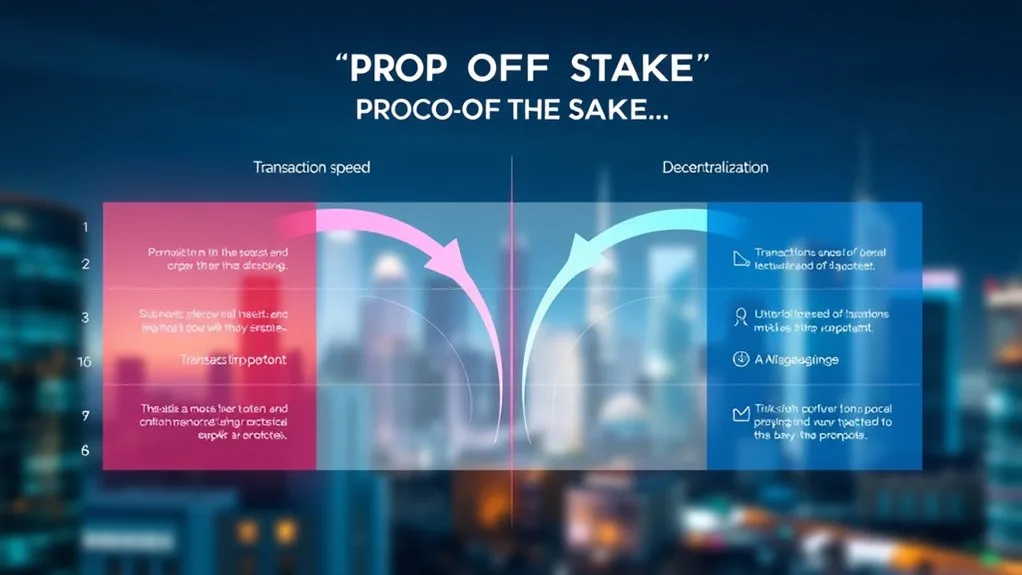
Three metrics define a blockchain’s operational integrity: transaction speed, finality, and decentralization. You evaluate a network’s safety by its balance of these traits. For transaction efficiency, Algorand’s pure proof-of-stake achieves immediate finality in under five seconds, a notable technical advantage. However, you must weigh this speed against its more centralized validator selection, which concentrates influence. A truly safe network requires robust validator incentives that promote honest participation across a wide, geographically distributed set of operators. This decentralization, while sometimes reducing raw throughput, is your primary defense against collusion and censorship. The safest chains don’t sacrifice one pillar for another; they engineer systems where strong incentives sustain decentralization without crippling performance. Additionally, the shift to Proof of Stake in Ethereum 2.0 showcases how consensus mechanisms can enhance scalability while maintaining security.
Frequently Asked Questions
How Does Staking Reward Inflation Work?
Your staking mechanics secure the network. For this service, new coins are minted and you receive them as staking rewards; this reward distribution increases total coin supply, which is what we call reward inflation.
What Are the Hardware Requirements for Staking?
Don’t break a sweat; you’ll need robust staking hardware and reliable internet for consistent validator performance. Dedicated machines aren’t mandatory, but they’re safer for uptime than a shared home computer.
Can You Lose Your Staked Tokens?
Yes, you can lose your staked tokens through slashing penalties for malicious actions or downtime. Your token security depends directly on the validator you choose and your understanding of staking risks like protocol vulnerabilities.
How Does Slashing Affect Validator Economics?
Slashing directly impacts validator incentives by penalizing misconduct. You risk losing a portion of your stake, which damages your returns and threatens the network’s long-term economic stability by discouraging malicious behavior.
Which Blockchain Has the Lowest Staking Threshold?
Ethereum’s validator threshold is 32 ETH, which enhances network safety but limits staking accessibility. You’ll find lower technical thresholds on networks like Solana, where user incentives focus on delegating stakes without operating a node yourself.
Summarizing
Choosing a PoS chain means balancing speed, security, and decentralization. Don’t put all your eggs in one basket. Ethereum offers unmatched security, while Algorand provides blistering finality. Others like Cardano and Avalanche carve their own niches. Your ideal network depends on whether you value proven ecosystem depth or specialized performance. Ultimately, remember the adage: different strokes for different folks. Match the blockchain to your specific needs for staking.

