

Layer 2 networks solve Ethereum’s speed and cost issues. They process your transactions on a separate chain, bundling them before settling on the mainnet. You’ll get faster, cheaper transfers while inheriting Ethereum’s security. This primarily happens through rollup technology, which compresses transaction data. Understanding how these systems differ unlocks their potential for everyday use. Your journey into efficient crypto transactions starts by exploring these architectures further.
Table of Contents
Brief Overview
- Layer 2 networks execute transactions off-chain to make Ethereum faster and cheaper for users.
- Rollups batch transactions for efficiency, using either optimistic fraud proofs or zero-knowledge validity proofs.
- The Dencun upgrade, via EIP-4844, provides cheap data storage blobs, drastically reducing Layer 2 transaction costs.
- Security primarily relies on Ethereum’s base layer, but users must assess the trust model of each specific solution.
- Bridging assets to a Layer 2 involves a single mainnet transaction to receive usable wrapped tokens.
Why Ethereum Needs Layer 2 Scaling Solutions

While Ethereum successfully secured global settlement through its Proof of Stake consensus, its base layer simply isn’t built for the high transaction volume demanded by mass adoption. You’ll face inherent scalability challenges because its network of thousands of validators prioritizes security and decentralization over raw speed. These validators must process and agree on every single transaction, a deliberate but slow process. When usage spikes, this architecture directly causes transaction congestion on the main chain. You’ll experience this as high, unpredictable gas fees and slow confirmation times. This congestion makes routine interactions like swapping tokens or minting an NFT prohibitively expensive and unreliable for everyday use, limiting the network’s practical utility for users who prioritize safe, predictable operations. Moreover, Layer 2 solutions like Optimistic Rollups are essential to alleviate these issues and improve overall transaction efficiency.
How Layer 2 Networks Work: Execution vs. Settlement
Layer 2 networks solve Ethereum’s congestion by fundamentally separating transaction execution from final settlement. You execute your transactions on a dedicated, secondary chain—the L2—which acts as an off-chain execution environment. This separation is the core architectural shift that delivers speed and cost savings.
- Your transactions, along with thousands of others, are compressed into a single cryptographic proof or data batch through transaction batching.
- This batched data is periodically posted back to the secure Ethereum mainnet, also called Layer 1 (L1).
- The L1 then verifies the integrity of this batch, providing a secure settlement guarantee.
- This process preserves Ethereum’s foundational security while moving the computational heavy lifting off-chain.
- Your final asset ownership and state are ultimately anchored and enforced by the Ethereum consensus. Additionally, Ethereum 2.0’s sharding technology enhances scalability by allowing parallel transaction processing, further alleviating congestion on the main network.
Understanding Rollups: Ethereum’s Dominant Scaling Architecture
| What You Do | What the Rollup Does |
|---|---|
| Submit a transaction | Batches it with others |
| Pay a low L2 fee | Compresses the batch data |
| Use a familiar dApp | Posts final proof to Ethereum |
| Hold your assets | Inherits Ethereum’s security |
| Enjoy fast confirmation | Leverages off-chain execution |
Rollups play a crucial role in enhancing Ethereum’s scalability, especially with the implementation of Danksharding.
How Optimistic Rollups and Fraud Proofs Work
- A sequencer processes your transactions off-chain and posts a compressed batch, or “rollup,” to Ethereum alongside a new state root.
- You accept this new state as valid during a predefined challenge window, typically seven days.
- If you detect invalid transactions, you can submit Fraud Proofs during this window.
- These cryptographic proofs trigger a dispute resolution process on the main Ethereum chain.
- Successful Fraud Proofs revert the fraudulent batch, slashing the operator’s bond and protecting your funds.
- This mechanism enhances robust security by utilizing economic disincentives to deter malicious actions.
How Zero-Knowledge (ZK) Rollups and Validity Proofs Work
While Optimistic Rollups rely on a community watch, Zero-Knowledge (ZK) Rollups mathematically prove every batch’s correctness instantly with a validity proof. You get immediate finality because the proof, often a zk-SNARK, verifies all transactions are valid without revealing their details. This cryptographic guarantee is foundational for safety, as it removes any trust assumption or challenge period. The trade-off is computational intensity; generating this proof complexity requires significant off-chain resources. However, this upfront cost secures the system. For you, this means your assets on a ZK Rollup inherit Ethereum’s security the moment the validity proof is confirmed on-chain, enabling both rapid and secure withdrawals. Additionally, the recent Ethereum 20 upgrade, which achieved reduced average block mining time, enhances the overall efficiency of transactions on ZK Rollups.
How EIP-4844 Blobs Dramatically Reduce Layer 2 Fees
- Blobs provide separate, cheap data storage for rollups, moving bulk data off the expensive mainnet.
- This data automatically deletes after ~18 days, which eliminates permanent storage costs and enforces cost efficiency.
- Validators process blobs in parallel, preventing them from congesting standard Ethereum block execution.
- You get cryptographic guarantees that the data is available, protecting your transaction’s security.
- The system creates a predictable, low-fee environment, making your Layer 2 interactions reliably affordable.
- Furthermore, decentralization and network governance are enhanced through the use of blobs, ensuring a more resilient and democratic ecosystem.
Comparing Major Layer 2s: Arbitrum, Optimism, Base, and zkSync
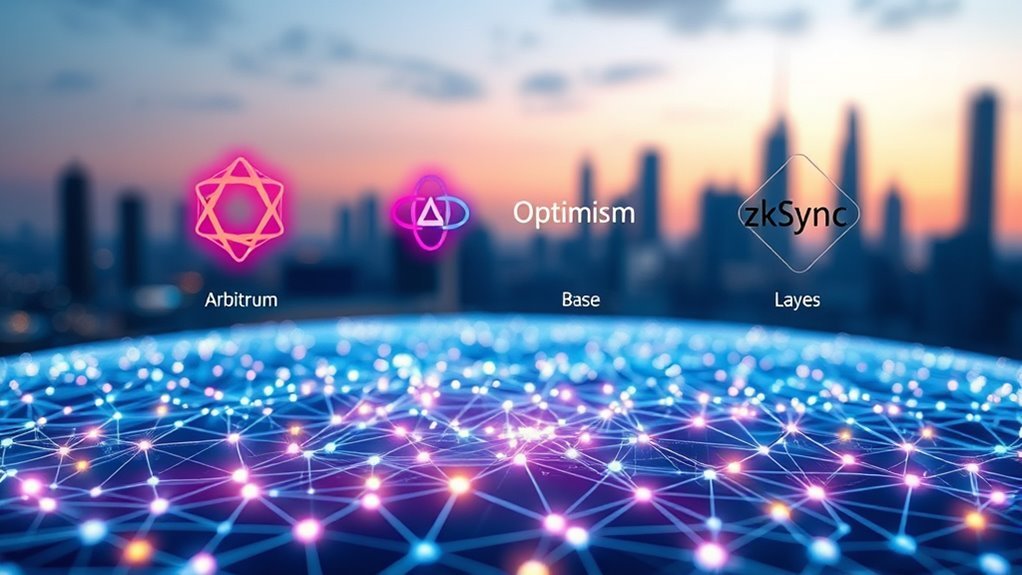
Because EIP-4844 blobs have made L2 transactions consistently affordable, the practical choice now hinges on architectural differences. For safety, you should prioritize proven security and decentralization. Arbitrum features include fraud proofs with multi-round challenges, providing strong economic security for its expansive ecosystem. You’ll find Optimism benefits in its straightforward, EVM-equivalent design and the shared security of its growing Superchain collective. The Base architecture leverages this Optimism stack with Coinbase’s institutional backing, focusing on developer accessibility and compliance. For speed, zkSync performance is notable, as its zero-knowledge proofs offer near-instant finality, though its newer proof system carries different trust assumptions. Additionally, the scalability solutions employed by these Layer 2s aim to enhance transaction throughput while maintaining security.
How to Bridge Assets to a Layer 2 Network
Moving assets from Ethereum’s mainnet to a Layer 2 network is a practical necessity for accessing scalable applications, and it’s achieved through a process called bridging. You initiate this through a bridge’s web interface, where you connect your wallet and select the asset and amount to transfer.
- Initiate the transfer on the official bridge portal for your chosen L2, confirming the transaction in your wallet.
- Await confirmation on mainnet, which typically involves a single, albeit slower, on-chain transaction.
- Receive wrapped assets on the L2, where the bridge’s smart contracts mint a representation of your original tokens.
- Verify transaction completion using a block explorer for both the mainnet and L2 transactions for full transparency.
- Utilize native bridges where possible to prioritize security and ensure smooth Layer 2 interoperability when bridging assets.
Additionally, as decentralized identity solutions are expected to grow alongside DApps, their integration into the bridging process could enhance user security and trust.
Are Layer 2s Secure? Assessing the Risks
How secure are Layer 2 networks? Their ultimate security derives from Ethereum, but specific Security Considerations depend on their architecture. Optimistic rollups require a trust assumption that someone will challenge invalid state changes during a challenge window. Zero-knowledge rollups offer stronger cryptographic guarantees, with validity proofs posted directly to mainnet. You must also assess the centralization risks of a network’s sequencer and prover operators, as these present potential points of failure. Effective Risk Mitigation involves choosing L2s with battle-tested code, robust fraud-proof or validity-proof systems, and clearly defined upgrade mechanisms. Your security also depends on using official, audited bridges and understanding that you’re trusting the L2’s smart contracts more than Ethereum’s base layer consensus. Additionally, awareness of potential 51% attack vulnerabilities can help you better evaluate the risks associated with different Layer 2 solutions.
The Future of Layer 2s and Ethereum’s Surge Upgrade

- The Dencun upgrade’s EIP-4844 blobs permanently lower L2 data costs, a foundational Surge step.
- Future upgrades will increase blob capacity, letting L2s batch more user transactions cheaply.
- This creates a stable fee environment, reducing cost volatility for your transactions.
- Enhanced data throughput reinforces the security inheritance from Ethereum’s consensus.
- Your focus shifts from worrying about base layer congestion to predictable L2 performance.
- This transition to Proof-of-Stake enhances the overall efficiency of the Ethereum network, benefiting Layer 2 solutions.
Key Innovations Shaping the Next Generation of Layer 2s
While the foundational rollup model is now proven, its next evolutionary stage is being defined by three core technical innovations: modular data availability layers, shared sequencing networks, and advanced proof systems. You’ll find modular data availability moving data off-chain to dedicated networks, which reduces costs and underpins a safer, more resilient Layer 2 Architecture. Shared sequencing networks allow multiple L2s to coordinate transaction ordering, boosting Transaction Efficiency while enabling secure cross-rollup interoperability. Finally, advanced proof systems like recursive zero-knowledge proofs compress verification work exponentially. These innovations collectively build a more secure, scalable, and performant multi-chain ecosystem centered around Ethereum.
Frequently Asked Questions
What Happens if a Layer 2 Network Shuts Down?
If an L2 shuts down, you lose service continuity. Your funds’ safety relies on network reliability and backup strategies, forcing a migration to preserve data integrity and restore user trust.
How Do Layer 2 Solutions Generate Revenue?
You might think they’d earn from token sales, but Layer 2s generate revenue primarily from your transaction fees. They collect these fees and use a portion for security payments and network incentives to attract users and developers.
Are My Assets on a Layer 2 Truly Non-Custodial?
Yes, you retain non-custodial control through your private keys. However, your Layer 2 security and privacy depend on the underlying protocol’s design and cryptographic proofs, impacting its overall adoption and interoperability with other chains.
Can I Use My Ledger Hardware Wallet on a Layer 2?
Yes, you can use Ledger compatibility with Layer 2 networks. It keeps your assets non-custodial, enhancing Layer 2 security. You’ll manage keys on your Ledger, but note the user experience and transaction fees are network-specific.
Do Layer 2 Networks Have Their Own Tokens?
Some have dedicated Layer 2 tokens for governance and fee payment, but others, like Base, use ETH. You’ll find token utility in securing the network, voting, or paying transaction fees directly.
Summarizing
You’ve seen how L2s quietly handle the heavy lifting, letting you transact without the old headaches. They’re not just a workaround; they’re the smooth path forward, turning yesterday’s bottlenecks into tomorrow’s background noise. So while the base layer stands guard, these nimble networks do the heavy work, making your crypto experience feel almost effortless. That’s the quiet revolution happening right under your fingertips.

