

You’re looking at five essential concepts that’ll transform your understanding of Bitcoin mining. First, you’ll discover what miners actually do—they’re validating transactions and securing the network, not just solving puzzles. You’ll learn how thousands compete globally for block rewards, why difficulty automatically adjusts to maintain consistent block times, and the real hardware and energy costs involved. Finally, you’ll see how the 2024 halving fundamentally shifted miner economics. Stick around to unpack each concept thoroughly.
Table of Contents
Brief Overview
- Bitcoin miners collect and verify transactions, bundling them into blocks to secure the network and prevent double spending.
- Miners compete globally using specialized hardware called ASICs to solve complex mathematical puzzles and claim block rewards.
- The first miner solving a valid block receives newly created Bitcoin plus transaction fees as their reward.
- Network difficulty automatically adjusts every two weeks to maintain consistent block times regardless of total mining participation.
- Electricity costs are miners’ largest expense, making low-cost power regions and efficient hardware critical for profitability.
What Bitcoin Mining Actually Does (Beyond “Solving Puzzles”)
Bitcoin mining secures the network and validates transactions—not just a computational race for rewards. When you mine, you’re performing block validation: collecting pending transactions, verifying their legitimacy, and bundling them into a block. This work ensures no one spends the same Bitcoin twice.
The incentive structure rewards you with newly created Bitcoin plus transaction fees, but that’s secondary to your role. Your computational power contributes to network security by making attacks prohibitively expensive. Every miner strengthens the chain’s immutability.
Transaction confirmation depends on miners. Without them, the blockchain stalls. Your hardware’s hash rate determines how often you’ll discover valid blocks, but every miner—regardless of size—protects the protocol’s integrity. Mining isn’t about getting rich fast; it’s infrastructure work that keeps Bitcoin trustworthy and decentralized. Additionally, miners must consider electricity costs as they significantly impact overall profitability.
How Miners Compete and Win Block Rewards
Mining competition operates on a straightforward principle: the first miner to find a valid block solution broadcasts it to the network and claims the reward. You’re competing against thousands of miners globally, each running specialized hardware to solve cryptographic puzzles.
Your mining competition strategies depend on your resources. Large operations deploy Application-Specific Integrated Circuits (ASICs) optimized for Bitcoin’s SHA-256 algorithm, giving them computational advantages. Smaller miners often join pools, combining their hashpower to increase odds of winning shares of block rewards.
Block reward mechanisms work like this: you validate transactions, bundle them into a block, and solve the puzzle first. Currently, you’d earn 3.125 BTC per block plus transaction fees. The difficulty adjusts every 2,016 blocks to maintain roughly 10-minute intervals between blocks, ensuring fair competition regardless of total network hashpower.
Why Bitcoin Mining Difficulty Automatically Adjusts
If you’ve noticed that Bitcoin blocks arrive roughly every 10 minutes—whether the network’s total hashpower doubles or halves—you’re witnessing the difficulty adjustment mechanism at work.
The Bitcoin protocol automatically recalibrates mining difficulty every 2,016 blocks (approximately two weeks). This self-adjusting system ensures consistent block times despite fluctuating hashrate. When more miners join and compete for rewards, the difficulty increases. When miners drop off, it decreases. This mechanism protects network security by maintaining predictable issuance rates and preventing any single entity from controlling block production timelines.
Without automatic difficulty adjustment, faster hardware adoption would compress block intervals, destabilizing transaction confirmation times and potentially compromising security. The algorithm uses past block timestamps to calculate the new difficulty target, ensuring the network remains resilient regardless of mining participation levels. Additionally, these adjustments influence miner profitability and ensure that a diverse range of participants can engage in the ecosystem.
The Hardware and Energy Reality Behind Mining Profitability
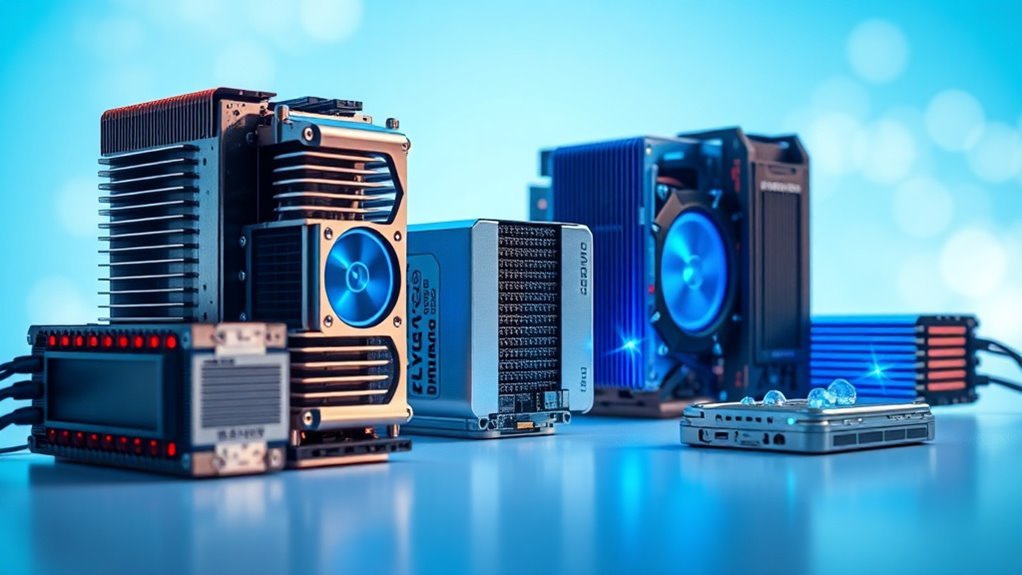
Your hardware choices directly determine your hashrate and power draw. Modern ASIC miners like the Antminer S21 deliver better energy efficiency than older models, but they cost thousands upfront. Electricity is your largest ongoing expense; miners in regions with cheap power (under $0.05/kWh) have a structural advantage. Optimizing performance also helps ensure that you’re maximizing your return on investment by reducing operational costs.
Join mining pools to smooth revenue volatility. Pools distribute block rewards across many participants, making income more predictable than solo mining. Calculate your profitability using hashrate, difficulty, and local electricity rates. If your operating costs exceed block rewards, you’re not mining—you’re subsidizing the network.
How the 2024 Halving Changed Miner Economics
When the Bitcoin network halved block rewards on April 2024, miners faced an immediate and brutal recalibration: overnight, the subsidy for solving each block dropped from 6.25 BTC to 3.125 BTC, cutting revenue in half while your electricity bill stayed the same. This halving impact forced a hard choice—upgrade to newer, more efficient hardware or shut down unprofitable operations. Miners with older equipment, particularly those in regions with high energy costs, exited the network entirely. The miner incentives shifted dramatically: only operations running the latest ASICs in low-cost electricity zones remained viable. Increased competition from miners using advanced technology became a defining feature of the post-halving landscape. Transaction fees became more critical to profitability, pressuring the network toward higher activity. This consolidation strengthened Bitcoin’s security by concentrating hashrate among well-capitalized, efficient operators.
Frequently Asked Questions
Can I Mine Bitcoin Profitably on My Laptop or Personal Computer?
No, you can’t mine Bitcoin profitably on your laptop. Modern mining demands specialized ASIC hardware and cheap electricity. Your laptop’s energy consumption will far exceed any Bitcoin rewards you’d earn, making it economically unviable.
What Happens to Miners’ Revenue When the Next Halving Occurs in 2028?
Your mining revenue won’t magically double—it’ll actually be cut in half. When the 2028 halving hits, you’ll earn 1.5625 BTC per block instead of 3.125. Smart miner strategies shift toward efficiency and lower operational costs to survive.
How Do Mining Pools Work, and Should I Join One?
You combine computing power with other miners in a pool to solve blocks faster and share rewards proportionally. Mining pool benefits include steady income and lower variance, but you’ll face mining pool risks like fee costs, operator reliability concerns, and reduced solo control over your earnings.
What’s the Difference Between Proof-Of-Work and Proof-Of-Stake Mining?
You’re comparing two different mining algorithms. Bitcoin uses proof-of-work, where you solve computational puzzles to secure the network. Proof-of-stake requires you to hold coins as collateral instead—it’s less energy-intensive but Bitcoin doesn’t use it.
How Much Electricity Does a Single Bitcoin Transaction Actually Consume?
You’re looking at roughly 1,500–2,000 kWh per transaction when you account for Bitcoin’s total network energy use divided by transaction volume—though this figure fluctuates with network activity and mining efficiency improvements that reduce environmental impact.
Summarizing
You’ve now journeyed through mining’s intricate dance—where computational effort gracefully becomes financial reward. The 2024 halving‘s gentle reduction in block rewards challenges miners to refine their operations, while difficulty adjustments maintain Bitcoin’s steady rhythm. Understanding these mechanics transforms you from a curious observer into an informed participant in the network’s security theater. You’re ready to engage with mining’s economic landscape more thoughtfully than ever before.

