


You’re experiencing Ethereum’s scaling evolution right now—proto-danksharding (EIP-4844) launched in March 2024, slashing Layer 2 fees by 90% through blob storage. Full danksharding’s arriving via a phased approach: Holesky testnet validates mechanics, staging layers identify edge cases, then mainnet rolls out gradually with validator subsets. You’ll see sustained 40 Mbps throughput demands and 18-day blob storage requirements reshape validator economics. The complete picture reveals critical trade-offs around MEV concentration, hardware costs, and governance decisions that’ll define Ethereum’s decentralization future.
Table of Contents
Brief Overview
- Proto-Danksharding (EIP-4844) launched in March 2024’s Dencun upgrade, reducing Layer 2 fees by 90%+.
- Holesky testnet currently tests full danksharding mechanics before mainnet deployment phases begin.
- Phased mainnet rollout starts with validator subset, monitored for finality, MEV impact, and network health.
- Blob data storage spans approximately 18 days with costs roughly 1/16th of traditional calldata expenses.
- Verkle trees integration planned to enable stateless validation and reduce bandwidth requirements by 90%.
Proto-Danksharding Delivered: What EIP-4844 Actually Achieved

Proto-danksharding (EIP-4844) shipped in the Dencun upgrade (March 2024) and cut Layer 2 transaction fees by 90%+ through temporary blob storage separate from permanent calldata. You’re now using a dual-storage model: blobs exist for roughly 18 days before expiring, dramatically reducing the cost burden Layer 2 sequencers pass to users. This proto danksharding benefits rollups like Arbitrum and Optimism, which compress transaction data and post it as blobs instead of expensive mainnet storage. Your transaction scalability improves because blob space costs far less than calldata—currently around 1/16th the price. Full danksharding, arriving in later roadmap phases, will further optimize validator data sampling and increase blob throughput. For now, EIP-4844 represents the critical bridge between Layer 1 constraints and sustainable L2 economics. Additionally, this upgrade aligns with the growing trend of Optimistic Rollups that enhance scalability and efficiency for Ethereum applications.
Why Full Danksharding Needs Verkle Trees
EIP-4844 solved the immediate fee problem for rollups, but it doesn’t solve the underlying bottleneck: validators still need to download and verify the entire Ethereum state to participate in consensus. Full danksharding requires a fundamental architectural shift—one that Verkle trees enable.
Why Verkle trees matter:
- Replace Merkle trees with polynomial commitments, reducing proof sizes from kilobytes to bytes
- Enable stateless validation: validators verify blocks without storing gigabytes of state data
- Cut bandwidth requirements by 90%, lowering hardware barriers for node operators
- Support recursive proofs, allowing light clients to verify Ethereum without full history
- Enhanced security ensures that the transition to PoS improves overall network integrity.
State efficiency through Verkle trees transforms danksharding from a throughput upgrade into a sustainability upgrade. You’re not just scaling transaction volume—you’re decentralizing validation itself by making participation accessible to resource-constrained operators.
Proposer-Builder Separation: Why It’s Essential for Danksharding
As danksharding scales blob throughput from kilobytes to megabytes per slot, you’ll face a new problem: a single validator can’t both propose a block and construct it optimally under MEV pressure. Proposer-builder separation (PBS) splits these proposer roles into two functions: proposers select which block to include, while specialized builders compete to construct the most profitable one. This division prevents validators from exploiting MEV themselves—reducing centralization pressure on staking hardware. Builder incentives remain competitive because multiple builders bid for block inclusion rights, ensuring fair pricing and reducing the ability of any single entity to extract excess value. PBS hardens the network against validator cartelization and makes danksharding’s expanded blockspace economically sustainable without compromising decentralization or individual validator participation. Furthermore, this mechanism aligns with the goals of Validator Empowerment, enhancing the overall security and efficiency of Ethereum’s PoS system.
Timeline Milestones: Testnet, Staging, and Mainnet Deployment
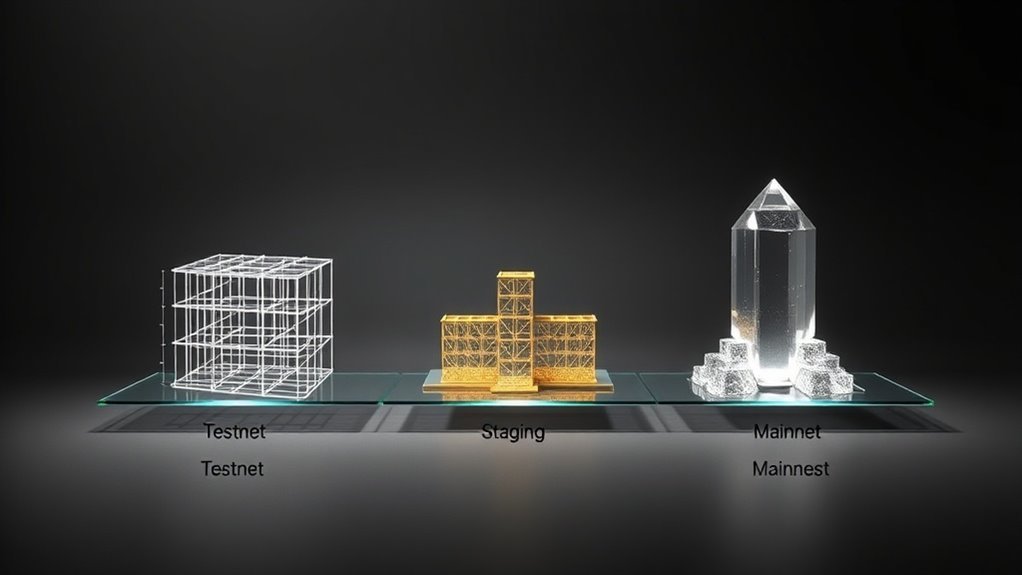
- Holesky testnet: Full danksharding mechanics tested with validator sets matching mainnet scale.
- Staging layer: Pre-mainnet environment running actual consensus rules to catch edge cases.
- Mainnet phased rollout: Initial deployment to subset of validators, gradual expansion.
- Monitoring period: Extended observation window measuring finality, MEV impact, and network health.
This graduated approach isolates risk. You’re not betting the entire network on untested cryptography. Each stage validates assumptions before the next escalates stakes, ensuring that the transition to Proof of Stake is both secure and efficient.
How Layer 2s Will Use Danksharding’s 64 MB Slots
When proto-danksharding (EIP-4844) shipped in March 2024, it carved out a dedicated blob space—roughly 0.375 MB per slot—that Layer 2s could use to post transaction data at a fraction of the cost of mainnet calldata. Full danksharding will expand that to 64 MB per slot, multiplying Layer 2 efficiency by orders of magnitude.
You’ll see rollups like Arbitrum and Optimism batch thousands of transactions into single blobs, compressing data and reducing per-transaction costs by 90% or more. Higher transaction throughput follows naturally—chains can confirm more activity per slot without congesting the base layer. zkSync and Starknet gain similar advantages, though they’ll encode proofs differently. The result: Layer 2s transition from congestion bottlenecks to genuine scaling solutions, letting you execute trades and transfers for pennies instead of dollars. This transformation echoes the enhanced transaction throughput capacity achieved through the Ethereum 20 upgrade, which allows for more transactions and substantial cost savings for users.
Danksharding’s Validator Hardware Requirements: The Bandwidth Ceiling
Expanding blob space from 0.375 MB to 64 MB per slot doesn’t come free—it demands validators run substantially faster network connections and storage infrastructure. You’ll need to assess your hardware capacity against real-world bandwidth optimization demands.
- Network bandwidth: Full danksharding requires ~40 Mbps sustained throughput during block production and attestation phases
- Storage scaling: Validators must retain blob data for ~18 days, necessitating additional SSD capacity beyond current mainnet requirements
- Validator performance: CPU overhead increases as you process larger data commitments and verify polynomial proofs
- Geographic latency: Regional proximity to peers becomes critical; high latency increases orphaning risk on larger blobs
These constraints create a natural validator hardware ceiling. Smaller operators may face economic pressure, potentially accelerating centralization unless client optimization improves. Additionally, as Ethereum transitions to Proof-of-Stake, the demand for traditional mining hardware will diminish, further influencing validator operations.
What Danksharding Delivers vs. What It Doesn’t

Because scaling isn’t monolithic, you need to distinguish between what danksharding actually solves and where it leaves gaps. Danksharding benefits Layer 2 networks by dramatically reducing blob storage costs—Dencun’s proto-danksharding already cut rollup fees by 90% or more. Full danksharding will extend this through 2D sampling and larger blob space, addressing throughput constraints on L2s.
However, danksharding doesn’t solve execution latency, validator hardware standardization, or architectural challenges around MEV at settlement layers. It won’t replace sharding for mainnet state storage or eliminate the need for Verkle trees during the Verge phase. Danksharding is precisely a data availability layer upgrade—it optimizes bandwidth for rollup calldata, not smart contract computation speed or consensus finality improvements. This optimization aligns with Ethereum’s focus on scalability improvements, ensuring a more efficient ecosystem for developers and users alike.
Governance Trade-offs: Samples, MEV, and Validator Economics
Danksharding’s data layer efficiency creates new pressure points elsewhere in Ethereum’s economic and governance model. You’ll face critical decisions around validator incentives and governance challenges that weren’t urgent before.
- Blob pricing volatility: Variable demand for blob space affects validator revenue predictability
- MEV concentration risk: Proposers gain asymmetric advantage in ordering blob transactions, potentially centralizing sequencing power
- Validator stake economics: Higher throughput demands more robust infrastructure; smaller validators may struggle profitably
- Governance complexity: Community must coordinate on blob retention policies, pricing mechanisms, and incentive adjustments
These trade-offs aren’t flaws—they’re inherent to scaling. You’re choosing between mainnet congestion and accepting distributed economic pressure. Ethereum’s governance forums and core developers are actively debating optimal parameters, but no solution eliminates all friction entirely. Additionally, the challenges of 51% attacks highlight the need for vigilant governance to protect network integrity amidst these changes.
Frequently Asked Questions
Can I Run a Full Node After Danksharding Without Enterprise-Grade Infrastructure?
Yes, you can run a full node post-danksharding on modest hardware—though you’ll need 2TB storage and stable internet. Infrastructure alternatives like light clients or staking pools let you participate safely without enterprise-grade equipment.
How Does Danksharding Affect Transaction Finality Times on Mainnet Versus Layer 2s?
You’ll see mainnet finality remain at ~12 seconds post-danksharding, but Layer 2s gain meaningful advantages through blob storage optimization. Your L2 transactions settle faster via reduced calldata costs, though mainnet’s finality guarantees stay anchored to validator slot times.
Will Danksharding Reduce Gas Fees for Users on Ethereum Mainnet Directly?
No—danksharding won’t directly reduce your mainnet gas fees. It’s designed to lower Layer 2 costs through blob storage. For mainnet gas fee reduction, you’ll need future upgrades like Verkle trees and state expiry.
What Happens to Existing Layer 2 Solutions if Danksharding Rollout Delays Occur?
Your Layer 2 solutions continue operating independently if danksharding delays occur. You’ll face sustained scalability challenges and implementation risks, but you’re protected—existing alternatives keep ecosystem adaptation moving forward without mainnet dependency.
Does Danksharding Require Wallet or Smart Contract Code Changes From Users?
You won’t need wallet compatibility changes or smart contract adjustments. Danksharding operates at the protocol layer, so your existing tools remain fully functional. Layer 2 applications benefit automatically without any action required from you.
Summarizing
You’re watching Ethereum’s scaling evolution unfold before your eyes, and danksharding isn’t just another upgrade—it’s the real deal. Proto-danksharding’s already proven the concept works, slashing Layer 2 fees dramatically. As you move toward full implementation, you’ll need to keep your finger on the pulse of validator requirements and L2 adoption rates. The writing’s on the wall: danksharding’s your ticket to Ethereum’s high-throughput future.

