


You couldn’t trust institutions that’d just obliterated $2 trillion in retirement savings, so when Satoshi Nakamoto handed you cryptographic keys to opt out entirely, the crypto community formed around that radical promise. Bitcoin solved decades-old problems—the double-spending issue, the need for intermediaries—without requiring faith in banks or regulators. You’d found something revolutionary: decentralized consensus through proof-of-work. Early miners connected on IRC, validating transactions together, building trust pseudonymously. What started as nine miners became something far larger, though the full story of how Bitcoin proved this concept deserves deeper exploration.
Table of Contents
Brief Overview
- Trust in traditional financial institutions collapsed following the 2008 Lehman Brothers crisis and regulatory failures, prompting alternative systems.
- Satoshi Nakamoto’s Bitcoin whitepaper solved the double-spending problem without intermediaries, enabling decentralized peer-to-peer transactions for the first time.
- Early adopters shared libertarian ideals rejecting government monetary control, seeking sound money backed by scarcity rather than political authority.
- Bitcoin’s pseudonymous design addressed privacy concerns about financial censorship and capital controls, appealing to privacy-conscious individuals and experimenters.
- The successful January 2009 network launch and early peer-to-peer transactions demonstrated Bitcoin’s practical viability, validating the decentralization promise.
The Cypherpunk Dream: Decades of Failed Attempts at Digital Money

Cypherpunks in the 1980s and 1990s pursued cryptographic solutions to digital currency but faced fundamental obstacles: the double-spending problem and the need for trusted intermediaries. You couldn’t simply send encrypted data and expect the recipient to trust it was genuine or unspent. David Chaum’s DigiCash attempted anonymous digital cash but required a central bank to prevent fraud. Other schemes collapsed under similar constraints—they all needed someone to verify transactions and prevent double-spending. The cypherpunk legacy shows you can’t escape mathematics: without a decentralized consensus mechanism, you’re trapped choosing between privacy and security. Bitcoin’s breakthrough in 2009 solved what decades of brilliant cryptographers couldn’t: creating digital cash that works without intermediaries, using proof-of-work to secure the network against fraud. This innovation also introduced decentralized blockchain technology, which further enhanced transaction security and transparency, sparking the community.
The 2008 Banking Collapse: Why Trust in Traditional Finance Broke
When Lehman Brothers collapsed in September 2008, it exposed a hard truth: the institutions you trusted to safeguard your money had been betting against your financial security. Banks had packaged risky mortgages into securities, sold them globally, then watched the market implode—taking your savings with it.
| Institution | Pre-Collapse Trust | Post-Collapse Reality |
|---|---|---|
| Banks | “Safe custodians” | Reckless speculators |
| Regulators | “Watchdogs” | Asleep at the wheel |
| Credit Rating Agencies | “Objective evaluators” | Complicit in deception |
| Government | “Lender of last resort” | Taxpayer-funded bailouts |
| Your Retirement Fund | “Protected” | $2+ trillion in losses |
The lack of banking trust and financial transparency became undeniable. You couldn’t verify where your money went or how institutions managed it. This breakdown created the conditions for Bitcoin’s emergence—a system requiring no intermediaries, no opacity, and no blind faith. Additionally, the rise of decentralized financial services offered a new pathway for individuals to regain control over their financial futures.
Satoshi’s White Paper: How Bitcoin Solved the Double-Spend Problem
Satoshi Nakamoto’s 2008 white paper introduced a cryptographic solution to the double-spend problem, enabling digital currency without a trusted intermediary. Before Bitcoin, digital currency faced a fundamental flaw: nothing prevented you from spending the same digital coin twice. Satoshi’s innovation solved this through a decentralized consensus mechanism.
Here’s how it worked:
- Timestamped transactions recorded in a permanent ledger
- Cryptographic hashing made tampering computationally infeasible
- Distributed validation eliminated reliance on banks
- Proof-of-work consensus secured the network against fraud
- Immutable record-keeping ensured transaction finality
This breakthrough made digital currency viable for the first time. You no longer needed to trust a central authority to prevent double-spending. Instead, the network itself enforced rules mathematically. This foundation attracted early adopters who valued financial sovereignty and security over traditional banking intermediaries. Moreover, the introduction of Bitcoin also coincided with concerns about energy consumption in mining, highlighting the need for sustainable practices in the cryptocurrency sector.
The January 2009 Genesis Block: Bitcoin Goes Live
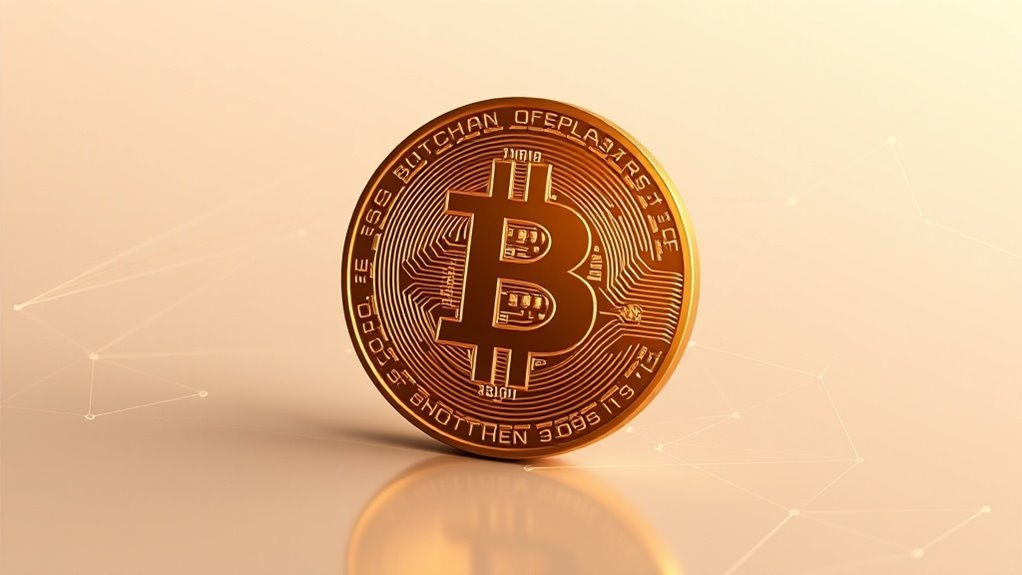
On January 3, 2009, the Bitcoin network came into existence with a single transaction—the creation of the genesis block, a 50 BTC reward that Satoshi Nakamoto couldn’t spend. This deliberate constraint proved foundational: it demonstrated that even the creator had no special privileges, establishing Bitcoin as truly decentralized from day one.
| Aspect | Details | Significance |
|---|---|---|
| Block Height | 0 | Network origin point |
| Timestamp | January 3, 2009 | Proof of existence |
| Coinbase Reward | 50 BTC (unspendable) | No creator advantage |
Early adoption began immediately after. The first peer-to-peer transaction occurred weeks later when Hal Finney received 10 BTC from Satoshi. These transactions weren’t accidents—they validated the network’s core promise: financial transactions without intermediaries, with no single entity controlling the system. The importance of this decentralized approach is underscored by the eventual introduction of Bitcoin mining rewards, which incentivize participants to maintain the network.
Why Proof of Work Became Bitcoin’s Foundation
The decentralized network Satoshi launched needed a mechanism to prevent double-spending and secure the ledger without a trusted authority—and that’s where Proof of Work (PoW) entered the picture. You don’t need a bank to validate transactions when miners compete to solve cryptographic puzzles, earning newly minted Bitcoin as reward.
This consensus mechanism protected early adopters by making attacks economically irrational:
- Miners must expend real computational energy to add blocks
- Invalid transactions get rejected by the network’s rules
- Rewriting history requires controlling 51% of total hashrate
- The cost of an attack exceeds potential gains
- Security strengthens as more miners join the network
Additionally, the network’s difficulty adjustments help ensure that block creation remains consistent, further enhancing security and stability.
PoW transformed Bitcoin from theory into a self-securing system. You’re protected not by corporate promise, but by mathematics and economic incentive alignment.
Mining From a Laptop: Why Early Bitcoin Attracted Technical Builders
In 2009, you could mine Bitcoin on consumer hardware and actually win blocks. That accessibility was revolutionary for technical builders who’d grown skeptical of centralized finance. A laptop with decent CPU power could compete fairly—no specialized equipment required, no gatekeepers deciding who participated.
This democratization attracted programmers and cryptography enthusiasts worldwide. They weren’t chasing wealth; they were solving a problem Satoshi posed: a peer-to-peer electronic cash system. Laptop mining meant you could verify the network yourself, run a full node, and contribute directly to security.
Early adopters understood the technical merit. They built communities around implementation details, discussing consensus mechanisms and cryptographic proofs. That technical foundation—people actually running and mining Bitcoin themselves—created the first real believers. The network’s credibility came from participation, not promises.
Moreover, the early environment of mining pools allowed for collaborative efforts that enhanced success rates among participants.
The First Bitcoin Transaction: Laszlo’s Pizza Purchase

A programmer named Laszlo Hanyecz posted to the Bitcoin Talk forum on May 18, 2010: he’d pay 10,000 BTC for two large pizzas.
What made this Bitcoin transaction historically significant:
- First real-world commerce: Demonstrated Bitcoin could function as a medium of exchange, not just a theoretical asset.
- Community formation catalyst: Proved early adopters believed in practical utility beyond speculation.
- Economic implications: Established precedent for pricing goods in Bitcoin, valuing the network’s actual use.
- Cultural significance: The event became shorthand for Bitcoin’s viability as currency.
- Risk acceptance: Both parties accepted volatility—Laszlo gambling on Bitcoin’s future, the seller accepting unknown asset value.
This purchase bridged mining and real adoption. You couldn’t buy pizzas with hashrate alone. Laszlo’s willingness to spend his coins for consumables signaled confidence that others would eventually accept Bitcoin. That transaction validated the peer-to-peer vision Satoshi outlined. Additionally, it highlighted the growth potential of Bitcoin as it began to reflect its value in everyday transactions.
Privacy by Design: How Pseudonymity Drew Early Adopters
Once Laszlo proved Bitcoin could buy pizza, the question became: who’d actually want to spend it?
You weren’t signing transactions with your legal name. Bitcoin’s pseudonymous design meant you could transact without exposing your identity to merchants, platforms, or surveillance. That separation appealed to early adopters facing real privacy concerns—whether financial censorship, capital controls, or simple preference for confidentiality.
The pseudonymous benefits extended beyond privacy. You could experiment with transfers, test the network, and hold value without institutional gatekeepers tracking your moves. No bank freezing accounts. No government monitoring flows.
This design choice drew people skeptical of traditional finance. They weren’t necessarily hiding illicit activity; they valued autonomy over transparency. That appeal—control without intermediaries—became foundational to Bitcoin’s earliest community formation. Moreover, the use of secure payment gateways ensured that transactions could be conducted with heightened privacy and reduced risk of data breaches.
Building Community on IRC: How Early Miners Connected
Early Bitcoin miners relied on Internet Relay Chat (IRC) channels to coordinate, troubleshoot, and validate network assumptions in real time. You’d connect to dedicated channels where developers and miners shared block data, discussed difficulty adjustments, and confirmed whether the network was operating as intended.
This early communication infrastructure served critical functions:
- Real-time problem-solving — Miners could report bugs or anomalies immediately
- Difficulty validation — Collaborative verification of mining parameters across nodes
- Network health monitoring — Peers confirmed synchronized blockchain state
- Resource sharing — Discussion of hardware configurations and optimization techniques
- Trust building — Repeated interaction established credibility among pseudonymous participants
IRC’s decentralized, text-based nature aligned perfectly with Bitcoin’s ethos. You didn’t need accounts or corporate intermediaries—just a client and channel access. This miner collaboration directly shaped Bitcoin’s early resilience and informed protocol decisions that persist today.
Why Bitcoin Outlasted B-Money, Bit Gold, and Other Predecessors

Before Bitcoin arrived, several cryptographers had already sketched the blueprint for digital money—B-Money, Bit Gold, and a handful of other proposals existed in academic papers and mailing lists, yet none achieved network adoption or survived beyond theoretical interest. Bitcoin succeeded where they failed because Satoshi Nakamoto solved the double-spending problem without requiring trusted intermediaries. You didn’t need to rely on a central authority to verify transactions. The digital currency evolution accelerated when open-source code met economic trust issues. Early miners could participate directly, verify the ledger themselves, and build genuine consensus. B-Money and Bit Gold lacked this decentralized mechanism and practical implementation. Bitcoin’s combination of proof-of-work, pseudonymous participation, and transparent incentive alignment created the first cryptocurrency with real staying power and community momentum. The reduction in block rewards post-halving further solidified Bitcoin’s position by ensuring a built-in scarcity that enhances its value over time.
Libertarian Ideals Met Sound Money: The Philosophical Catalyst
Bitcoin didn’t emerge in a vacuum—it crystallized decades of libertarian and Austrian economics thinking into working code. You’re looking at the convergence of two powerful ideas that shaped 2009’s crypto awakening:
- Distrust of central banking – Libertarian philosophy rejected monetary control by governments and central banks
- Sound money principles – Austrian economists argued for currency backed by scarcity, not political whim
- Cryptographic solutions – Cypherpunks developed tools to enforce these ideals technically
- Post-2008 catalyst – Bank bailouts validated critiques of fiat systems and central authority
- Peer-to-peer vision – Bitcoin enabled monetary exchange without intermediaries or permission
Satoshi Nakamoto synthesized these threads into a system where code enforces the rules. You didn’t need to trust institutions; mathematical consensus replaced human discretion. This philosophical alignment attracted early adopters who saw Bitcoin as libertarian philosophy made tangible—a monetary system reflecting Austrian economics in practice, not theory.
From Nine Miners to Global Movement: How Bitcoin Proved Its Concept
Philosophy alone doesn’t validate a monetary system—only network effects and real-world adoption do. When Satoshi Nakamoto released Bitcoin’s genesis block in January 2009, you witnessed Bitcoin Origins translated into executable code. Those nine early miners weren’t idealists; they were pragmatists testing whether decentralized consensus could actually work.
Their Community Evolution proved the concept’s viability. As more nodes joined, the network became genuinely censorship-resistant—not theoretically, but functionally. Technical Innovations like difficulty adjustment made Bitcoin self-regulating, eliminating reliance on central authorities.
Early Adoption accelerated through 2010-2011 as the Silk Road and pizza transactions demonstrated real-world utility. Financial Disruption became tangible when governments couldn’t shut down a network with no single point of failure. You’re witnessing the result: a proven alternative to fiat-dependent systems that started with nine miners and scaled globally.
Frequently Asked Questions
Did Early Bitcoin Miners Know the Asset Would Become Valuable Someday?
Most early miners didn’t predict Bitcoin’s value. You’d have found them motivated by technical curiosity and ideological beliefs in decentralized money—not asset valuation predictions. Some recognized potential; most simply couldn’t foresee today’s institutional adoption landscape.
How Did the Crypto Community Verify Bitcoin’s Code Without Trusting Satoshi?
You can verify Bitcoin’s code yourself—over 1,000 independent nodes now run full copies. That transparency means you’re not trusting Satoshi; you’re validating the code directly. Community trust builds through reproducible code validation, not authority.
What Technical Barriers Prevented Earlier Cypherpunk Projects From Gaining Traction?
You’d have found earlier cypherpunk projects lacked Bitcoin’s practical solutions: they couldn’t solve the double-spending problem without trusted intermediaries. Early technology constraints—limited computing power, network effects, and no proven consensus mechanism—made sustained adoption nearly impossible before 2009.
Were the First Bitcoin Adopters Primarily Motivated by Ideology or Profit?
You’ll find first Bitcoin backers balanced both motivations: principled privacy proponents pursued ideological motivations against centralized currency, while profit incentives drew pragmatic pioneers betting on breakthrough technology. Early adopters weren’t purely ideological—they hedged hopes with hushed hunches about value.
How Did Bitcoin’s Pseudonymity Protect Early Miners From Government Scrutiny?
You’re protected by Bitcoin’s pseudonymous design—your mining activity isn’t tied to your identity. Government agencies can’t easily trace your transactions or mining incentives without additional data, addressing early privacy concerns while you operate within the network’s decentralized structure.
Summarizing
You’ve inherited a revolution born from ashes. When the financial system crumbled in 2008, Bitcoin’s architects planted a seed in the rubble—one that grew into an unstoppable forest of decentralized believers. You’re not just holding currency; you’re clutching a philosophical torch passed from cypherpunks to miners to you. That community didn’t emerge by accident. It crystallized because you and millions like you refused to accept a rigged system.

