


You’re looking at mid-2028 for Bitcoin’s next block reward reduction, when miners’ rewards‘ll drop from 3.125 BTC to 1.5625 BTC. This halving occurs every 210,000 blocks—roughly every four years—and it’s crucial for controlling Bitcoin’s total supply at 21 million coins. Historically, these events have sparked bullish market reactions and significant price increases. Understanding how this reduction affects mining profitability, network security, and your investment strategy can help you navigate the opportunities ahead.
Table of Contents
Brief Overview
- The next Bitcoin halving is expected around mid-2028, reducing block rewards from 3.125 BTC to 1.5625 BTC.
- Halvings occur every 210,000 blocks, approximately every four years, and reduce miner rewards by 50%.
- The 2024 halving reduced block rewards from 6.25 BTC to 3.125 BTC, tightening miner margins immediately.
- Halving reduces miner income unless transaction fees rise, potentially causing less profitable miners to exit.
- Bitcoin’s supply cap of 21 million coins is enforced by halving events, creating predictable scarcity.
Bitcoin’s Next Halving Expected Around 2028
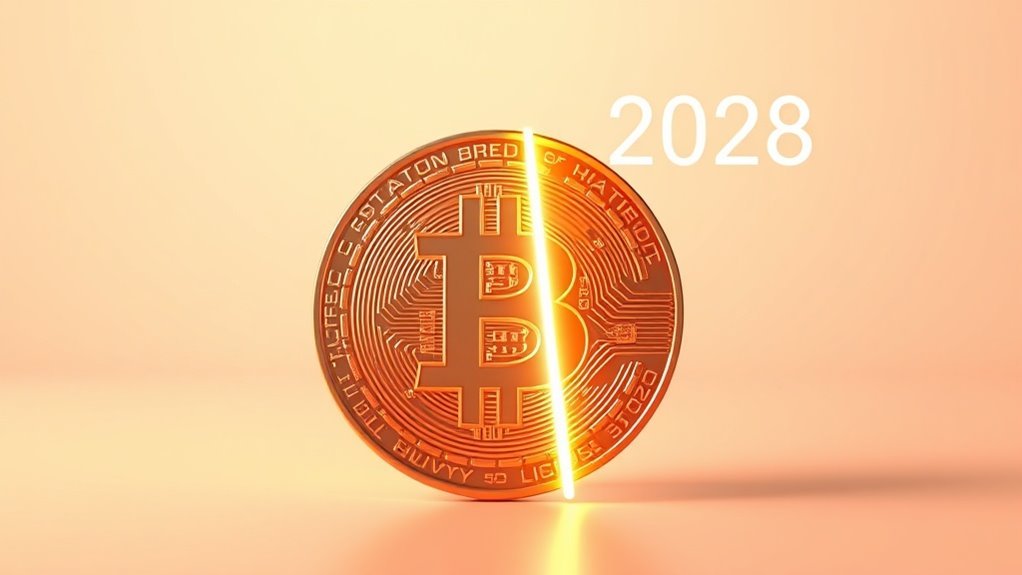
Bitcoin’s next halving is expected around mid-2028, approximately four years after the April 2024 event. This reduction will cut block rewards from 3.125 BTC to 1.5625 BTC per block, directly affecting miner economics and supply dynamics.
You should understand the halving impact extends beyond mining profitability. Historical data shows these events influence market cycles, though correlation isn’t causation. Future projections suggest reduced new supply could support long-term scarcity narratives, but you’ll want to avoid assuming automatic price appreciation. Additionally, the reduction in block rewards will necessitate miners to adapt their strategies to maintain profitability in a competitive landscape.
The 2028 halving represents a predictable milestone in Bitcoin’s 140-year emission schedule. For self-directed investors, tracking these events helps contextualize supply-side narratives without relying on speculation. Monitor miner behavior and difficulty adjustments in the months leading up to the event—these metrics often signal market sentiment more reliably than price action alone.
Understanding Bitcoin’s Halving Mechanism
Why does Bitcoin’s supply shrink every four years, and what does that actually mean for miners and holders?
Bitcoin’s halving mechanics reduce block rewards automatically every 210,000 blocks—roughly every four years. When a halving occurs, miners receive 50% fewer newly minted bitcoins for validating transactions. This constraint is hardcoded into Bitcoin’s protocol, making it predictable and unchangeable.
The mechanism serves two purposes. First, it controls Bitcoin’s total supply, capping it at 21 million coins. Second, it reshapes miner incentives by forcing operators to rely increasingly on transaction fees rather than block rewards for profitability. Additionally, the reduced supply post-halving contributes to increased demand and can drive significant price surges.
For holders, halvings create scarcity pressures. For miners, they demand operational efficiency. Understanding these halving mechanics helps you assess long-term network viability and mining economics without emotional speculation.
The 2024 Bitcoin Halving: What Happened Next
In April 2024, Bitcoin’s fourth halving reduced block rewards from 6.25 BTC to 3.125 BTC—a shift that immediately tightened miner margins and reshaped the network’s economics. You witnessed significant halving impact across mining operations: less-efficient miners faced pressure to upgrade or shut down, while network hashrate initially dipped before stabilizing at higher levels as stronger competitors consolidated.
| Metric | Pre-Halving | Post-Halving |
|---|---|---|
| Block Reward | 6.25 BTC | 3.125 BTC |
| Network Hashrate | ~680 EH/s | ~670 EH/s (temporary dip) |
| Average Block Time | 10 minutes | 10 minutes (maintained) |
Market reactions proved bullish despite immediate miner headwinds. Bitcoin’s price climbed toward $126,000 by October 2025, driven by spot ETF inflows and institutional adoption. You should understand that halvings compress supply growth while demand strengthened—a dynamic favoring longer-term holders over short-term miners navigating profitability challenges. The adjustments in mining difficulty ensure stability in block times, reflecting ongoing changes in miner participation and network security.
How Halvings Affect Mining Profitability and Network Security

When a halving cuts block rewards in half, you’re watching the economic foundation of Bitcoin’s security model shift in real time. Mining rewards drop from 6.25 BTC to 3.125 BTC per block—directly compressing miner income unless transaction fees rise to compensate.
Less profitable miners exit the network, which temporarily reduces hashrate but strengthens it long-term by eliminating inefficient operations. The network dynamics adjust: fewer, better-capitalized miners remain, and fee markets become more critical to security funding.
You need to understand that halvings test whether Bitcoin’s incentive structure remains intact. If mining becomes unprofitable network-wide, security could weaken. However, historical halvings have prompted fee increases and institutional adoption that offset reward reductions, maintaining network health and validator economics. Additionally, the Bitcoin supply cap plays a crucial role in driving demand and incentivizing miners to continue operations.
Why Bitcoin’s Fixed Supply and Halving Schedule Create Long-Term Value
Bitcoin’s 21-million-coin cap isn’t a marketing slogan—it’s a hard protocol rule that fundamentally separates it from every fiat currency and most other cryptocurrencies. This fixed supply creates predictable scarcity: you know exactly when the last Bitcoin will be mined (around 2140) and how many exist at any given moment.
Halvings enforce that scarcity by cutting block rewards on a predictable four-year schedule. The 2024 halving reduced rewards to 3.125 BTC per block; the next occurs around 2028. This predictability matters for long-term value because it removes inflation uncertainty. Governments can print money indefinitely; Bitcoin cannot. That mechanical constraint has anchored Bitcoin’s store-of-value proposition since its 2009 launch, attracting institutions and individuals seeking assets resistant to monetary dilution. The significance of supply dynamics in the cryptocurrency market further emphasizes Bitcoin’s unique characteristics and its potential for future appreciation.
How Markets Have Responded to Previous Halvings
Price surges don’t automatically follow halvings—but neither do they occur in a vacuum. You’ll find that historical trends reveal nuanced market reactions tied to broader adoption cycles rather than the halving event itself.
After the 2012 halving, Bitcoin traded around $5, then climbed to $1,100 within months. The 2016 halving preceded a sustained bull market that peaked near $20,000 in late 2017. Post-2020 halving, institutional inflows accelerated, driving prices toward $69,000 by late 2021.
What’s consistent: anticipation matters more than the actual event. Markets price in halvings ahead of time. You should track on-chain metrics, mining profitability shifts, and macroeconomic conditions alongside halving dates for clearer insight into potential price movement. Additionally, understanding the impact of halving events can provide valuable context for future price predictions.
Preparing Your Bitcoin Strategy Before the 2028 Halving

Understanding historical patterns is useful, but you’ll benefit far more from acting on that knowledge now—roughly two years before the 2028 halving arrives. Rather than chase market timing around the event itself, consider establishing consistent investment strategies today. Dollar-cost averaging into Bitcoin over the next 24 months smooths your entry point and removes the pressure of predicting exact price movements. Review your wallet security and exchange custody arrangements now, not in a rush closer to halving. Assess whether your risk tolerance aligns with potential volatility spikes. If you hold Bitcoin, rebalancing your portfolio before heightened activity reduces reactive decision-making. The 2028 halving won’t surprise the market—preparation does. Implementing a disciplined investment strategy, like Dollar-cost averaging, can significantly enhance your long-term gains while minimizing risks.
Frequently Asked Questions
Can Bitcoin’s Halving Schedule Ever Be Changed or Delayed by Developers?
No, you can’t change Bitcoin’s halving schedule. It’s hardcoded into the protocol’s consensus rules, and developers lack authority to alter it. Any change would require network-wide agreement, making halving implications predictable and your investment thesis safer.
What Happens to Miners Who Can’t Remain Profitable After Block Reward Reductions?
You’ll face tough choices: optimize your mining profitability through operational efficiency gains, diversify into alternative revenue streams like hosting services, or exit mining entirely. Market adaptation determines your survival when block rewards shrink.
How Does the Halving Affect Bitcoin’s Inflation Rate Compared to Fiat Currencies?
You’ve likely heard Bitcoin’s scarcity beats fiat inflation—it’s true. Each halving cuts your block rewards in half, capping Bitcoin’s supply at 21 million. Unlike fiat’s unlimited printing, you’re holding an asset with guaranteed deflation built in.
Do Halvings Typically Cause Price Volatility, or Is Correlation Overstated by Media?
You’ll find halving-linked volatility is real but complicated. Media narratives amplify speculative trading around these events. Historical trends show price moves correlate with market reactions—not the halving itself—making correlation overstated without broader context.
What Is the Final Bitcoin Halving, and When Will It Occur?
Bitcoin’s final halving occurs around 2140 when you’ll receive essentially zero block rewards. Historical halving trends show supply scarcity drives long-term value, but you shouldn’t depend on timing halvings for investment decisions—focus on fundamental holdings instead.
Summarizing
You’re watching Bitcoin’s heartbeat slow down as the 2028 halving approaches. Each reduction cuts the flow of new coins like a dimmer switch lowering the lights—scarcity intensifies while miners navigate tighter margins. By understanding this predictable rhythm, you’re positioning yourself ahead of market waves. The halving isn’t just a technical event; it’s Bitcoin’s built-in timer, ticking toward the next chapter of adoption and value discovery.

