

Your choice of cryptocurrency directly affects your privacy. Bitcoin’s public ledger exposes your activity, while Zcash offers opt-in privacy using zk-SNARKs. Monero provides the strongest default protection by hiding all details with ring signatures and stealth addresses. Each has different trade-offs in scalability and compliance, especially under upcoming regulations. Understanding this spectrum helps you manage your financial exposure, and there’s more to uncover about securing these assets.
Table of Contents
Brief Overview
- Bitcoin’s public ledger offers pseudo-anonymity vulnerable to analysis.
- Monero provides default, mandatory privacy via ring signatures and stealth addresses.
- Zcash features optional privacy using zk-SNARKs for selective transaction shielding.
- Privacy choice balances user protection with regulatory compliance requirements.
- Network performance and scalability are directly impacted by privacy mechanisms.
Why Bitcoin’s Transparency Is a Privacy Problem

While Bitcoin pioneered decentralized digital currency, its foundational transparency creates significant privacy risks for its users. Every transaction you make is permanently visible on a public ledger. This pseudo-anonymity doesn’t protect you; sophisticated blockchain analysis software can trace your transaction history and link your addresses to your identity over time. This exposure makes you vulnerable to surveillance, financial profiling, and even theft. High-profile attacks have proven that this transparency facilitates de-anonymization, drawing increased regulatory scrutiny. It’s this critical privacy gap that directly fueled the development and demand for true privacy coins, which are specifically designed to shield your financial activity from such public exposure and analysis. These alternatives, like Monero and Zcash, employ sophisticated cryptographic methods such as ring signatures and zero-knowledge proofs to ensure transaction anonymity.
The Privacy Spectrum: From Traceable Pseudo-Anonymity to Full Obfuscation
Given that every transaction leaves a trace, understanding the privacy spectrum is crucial for managing your financial exposure in crypto. You have Bitcoin’s transparent ledger on one end, where sophisticated analysis can de-anonymize you. Mid-spectrum, protocols like Zcash offer opt-in privacy using zk-SNARKs for Confidential Transactions that hide amounts. On the far end, Monero provides full obfuscation by default, masking all details with features like stealth addresses and ring signatures. Your choice determines what’s visible: value, participants, or nothing. In today’s environment, this isn’t just about anonymity; it’s about controlling your financial footprint against surveillance and ensuring your transactional safety. Selecting the right point on this spectrum is a fundamental security decision.
How Ring Signatures Hide the Sender (Monero’s Core Technology)

Several cryptographic innovations have fundamentally reshaped digital privacy, and ring signatures stand as one of the most critical for concealing a transaction’s origin. This is Monero’s core technology for protecting you. When you send XMR, your real output mixes with several decoy outputs from the blockchain to form an anonymity set. The transaction signs with this entire group, or “ring.” This cryptographic process validates the payment without ever revealing which ring member you are. It effectively severs the on-chain link between your sending address and the transaction. These ring signatures ensure your financial activity remains confidential by default, mitigating metadata leakage and providing a robust shield against surveillance. Monero’s commitment to continuous innovation has led to improved ring signatures that make tracing transactions significantly more difficult.
How Stealth Addresses Protect the Recipient (Monero and Zcash)
- Monero’s Automatic Generation: A sender automatically creates a unique stealth address for the recipient, protecting their main address from ever appearing on-chain.
- Historical Unlinkability: Payments to the same public address create entirely different stealth addresses, making transaction history analysis impossible.
- Zcash’s Shielded Pool: Recipient addresses are cryptographically concealed within shielded transactions, though this privacy is opt-in.
- Contrasting Philosophies: Monero provides mandatory, comprehensive protection for the recipient, while Zcash offers flexible, user-controlled privacy.
- Both technologies demonstrate the use of advanced encryption technology to enhance user confidentiality and transaction security.
How zk-SNARKs Enable Shielded Transactions (Zcash’s Cryptographic Engine)
zk-SNARKs serve as Zcash’s cryptographic engine, powering shielded transactions that allow you to validate a payment without revealing the sender, recipient, or amount. These proofs are compact, enabling secure and efficient verification within milliseconds for scalable mobile use. The system creates shielded z-addresses, isolating private activity from transparent t-addresses. You maintain control over your financial data, with zk-SNARKs providing the bedrock for your transactional anonymity. This cryptographic foundation also supports optional selective disclosure, letting you share specific details with trusted entities for compliance needs without compromising the core shielded protocol’s integrity. It’s a precise tool for achieving confidential settlement on the blockchain. Zcash uses this technology to offer users optional privacy, a key feature distinguishing it from some privacy coins that mandate anonymity for all transactions.
Default Anonymity vs. Opt-In Privacy: A Critical Design Divide
When choosing a privacy-focused cryptocurrency, you confront a fundamental architectural decision: whether privacy is a default feature or an optional one. This design divide is critical for your security posture and operational flexibility, especially under tightened 2026 regulations. Default anonymity, as employed by Monero, ensures every transaction inherently obscures sender, receiver, and amount through technologies like ring signatures. This uniform protection eliminates privacy leaks from user error but offers less formal compliance. Opt-in models, like Zcash’s, provide powerful shielded transactions using zk-SNARKs but require active user choice.
- Universal Protection: Systems with default anonymity guarantee a uniform privacy set for all users, protecting you even if you forget to enable a special mode.
- Compliance Pathways: Opt-in privacy allows for selective disclosure, letting you prove transaction details to auditors or regulators when necessary.
- User Responsibility: With optional privacy, you must actively choose to shield each transaction, introducing risk if you mishandle transparent addresses.
- Network Effect: Default anonymity strengthens collective privacy by making all transactions indistinguishable, whereas optional privacy can create identifiable patterns within a transparent ledger.
How Leading Privacy Coins Compare: Monero, Zcash, and Newer Contenders in 2026
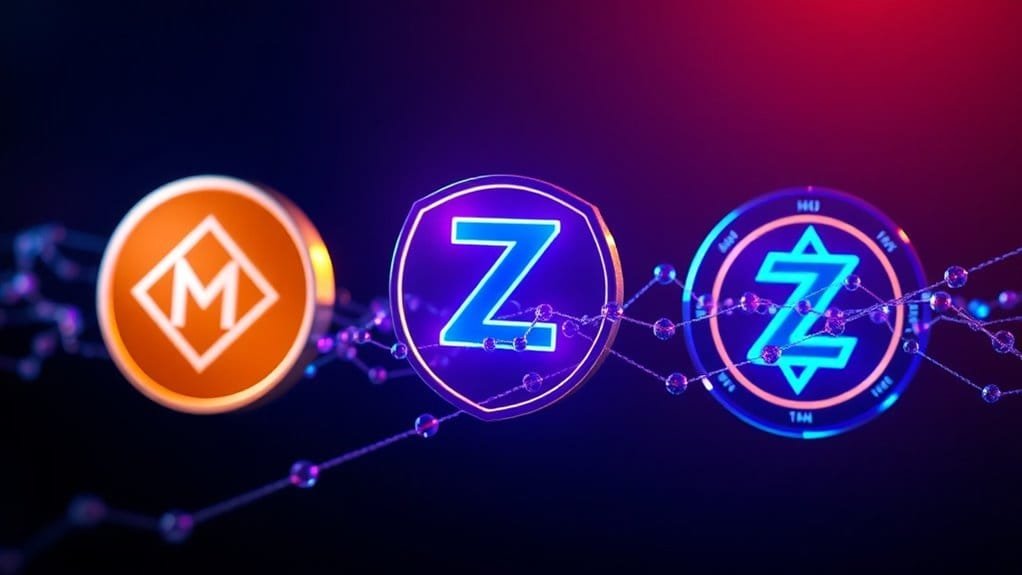
How do you evaluate privacy coins in today’s regulated market? Your primary criterion must be its fundamental privacy guarantees and how they withstand real-world analysis. Monero uses ring signatures and stealth addresses to enforce default anonymity, making every transaction confidential. Zcash offers selective privacy using zk-SNARKs for shielded transactions, which supports compliance via viewing keys. Newer contenders like Firo integrate advanced protocols aiming for similar security. Ultimately, you choose based on whether you require uniform, mandatory protection or an optional system that can demonstrate transaction legitimacy. The efficacy of these Confidential Transactions defines their viability in a landscape where regulatory pressure prioritizes transparency. Therefore, a project’s long-term viability increasingly depends on its adoption of regulatory-friendly technologies to balance privacy with compliance demands.
Comparing Privacy Feature Costs, Speed, and Network Performance
While privacy guarantees are foundational, the practical costs and performance of these systems directly affect daily use. Your choice influences the transaction fees you pay, the confirmation times you experience, and the overall network reliability you depend on. Cost efficiency varies significantly; Zcash’s shielded transactions using zk-SNARKs often incur higher fees than Monero’s automatically private ones. Evaluating these factors helps you select a system that operates securely without unnecessary expense or delay.
- Monero’s mandatory privacy features, like ring signatures, create larger, slower transactions, impacting network performance during peak usage.
- Zcash’s Halo 2 upgrade enhances proof-generation speed, making shielded transactions faster despite their potential for higher fees.
- Monero’s heavy transactions pose scalability challenges, requiring ongoing optimizations to manage growth effectively.
- Zcash’s unified addresses and ZIP-driven upgrades offer more flexible scalability and streamlined network performance.
What Are You Hiding From? Defining Your Personal Threat Model

Technical specifications and network fees are secondary if your privacy tools don’t match your specific risks. You must first define your personal threat model by identifying your potential adversaries. Are you protecting transaction amounts and counterparty details from government surveillance under MiCA, from cybercriminals, or from commercial data brokers? Your answer directly informs your technical choice. For instance, if concealing payment values is your primary concern, you require a protocol with robust Confidential Transactions. Evaluate the tools, like Zcash’s selective disclosure or Monero’s default privacy, against your specific dangers. Recognize that jurisdictional differences heavily impact enforcement and your practical safety; a measure effective in one region may be insufficient in another.
Choosing the Right Tool: Practical Use Cases for Each Privacy Method
Ultimately, the question is practical: given your defined threat model, which privacy tool should you actually use? Your specific need for safety dictates the correct choice. For robust, untraceable transactions, Monero’s automatic privacy is ideal. If you require compliance flexibility, Zcash’s opt-in model and viewing keys are superior. The sustainability of operations, including privacy coin mining, is further enhanced by leveraging renewable energy integration to significantly reduce both costs and environmental impact.
- For Complete Financial Confidentiality: Choose Monero. Its mandatory features like ring signatures and confidential transactions provide strong protection against chain analysis, crucial for personal privacy.
- For Auditability and Selective Disclosure: Use Zcash. Its shielded pools offer privacy, but you can prove payment details to auditors or regulators when necessary.
- Business Operations Requiring Transparency: Zcash’s dual transaction types let you shield internal transfers while using transparent addresses for public-facing, compliant invoices.
- Individual Protection from Surveillance: Monero’s uniform privacy is the default safe choice, severing the link between your transactions and public identity entirely.
Understanding the Risks: Privacy Coin Limitations and Attack Vectors
Given that privacy coins promise a shield from public scrutiny, they aren’t impervious to forensic analysis. Sophisticated network traffic and transaction graphing techniques can partially de-anonymize even advanced systems like Monero, revealing a key set of privacy coin limitations. For instance, Zcash’s optional shielding creates a vulnerability; forensic tools can analyze its transparent transactions to potentially link user activity. You must remember these are live protocols where attackers constantly adapt their methods, underscoring that no privacy is absolute. The technology, from ring signatures to zk-SNARKs, is in a persistent cat-and-mouse game. To stay safe, you need to understand these inherent risks, as improper use can render the strongest cryptographic anonymity ineffective.
How to Secure Privacy-Focused Cryptocurrencies in Self-Custody
While cryptographic shields protect your on-chain transactions, securing privacy coins in self-custody requires an infrastructure-focused approach to wallet and operational security. You must extend the principles of Confidential Transactions into your personal security setup. This discipline is non-negotiable for maintaining true financial safety.
- Use a Dedicated Hardware Wallet: Store assets like Monero or Zcash on a hardware wallet (e.g., OneKey) to isolate your private keys from internet-connected devices, providing a physical barrier against remote attacks.
- Enforce Full Protocol Privacy: Actively enable shielded or private sending modes (like Zcash’s shielded transactions) for every transaction to prevent metadata leakage from your wallet address.
- Maintain Impeccable Software Hygiene: Regularly update all wallet firmware and software to patch vulnerabilities that could deanonymize you or lead to theft.
- Implement Redundant, Secure Backups: Encrypt and store recovery seed phrases in multiple secure physical locations, ensuring you can recover your wallet without digital exposure.
The 2026 Regulatory Assault: MiCA, FATF, and Exchange Delistings

MiCA’s 2026 framework subjects all crypto assets in the EU, including privacy coins, to stringent licensing and compliance requirements. This directly challenges coins utilizing Confidential Transactions, as you can’t meet transparency rules while obscuring transaction data. The Financial Action Task Force (FATF) expands its Travel Rule, demanding exchanges identify both senders and receivers. If a protocol can’t provide that data, exchanges delist it to avoid massive fines, severely limiting your on-ramps. You’re navigating a landscape where regulatory pressure explicitly targets core privacy features.
| Regulation | Key Demand | Impact on Privacy Features |
|---|---|---|
| MiCA (EU) | Full licensing for issuers & CASPs | Mandates traceability, conflicting with native anonymity |
| FATF Travel Rule | Identify originators/beneficiaries | Forces VASPs to reject non-compliant assets |
| Exchange Policies | Adherence to above rules | Leads to delistings of coins like Monero or Zcash |
| AML Directives | Transaction monitoring | Renders Confidential Transactions a compliance risk |
| Global Standards | Regulatory harmonization | Creates a domino effect of restrictive policies worldwide |
Privacy Beyond Native Coins: Railgun and Ethereum Layer-2 Solutions
Even as regulatory pressure mounts on native privacy coins, solutions are emerging to provide privacy within existing, compliant blockchains. You can achieve Confidential Transactions without leaving the established Ethereum ecosystem. Protocols like Railgun utilize zk-SNARKs to shield your ERC-20 token transfers and balances. By operating on Layer-2 networks, these solutions also offer faster, cheaper private transactions while interacting with mainstream DeFi.
- Zero-Knowledge Proofs for On-Chain Privacy: Railgun uses zk-SNARKs to validate transactions without revealing sender, receiver, or amount on the public ledger.
- Layer-2 Scalability Integration: It leverages Ethereum’s Layer-2s to make private transactions cost-effective and practical for regular use.
- dApp Interaction with Privacy: You can use private balances to interact with decentralized applications without exposing your financial history.
- Selective Disclosure for Compliance: The system allows you to cryptographically prove specific transaction details to auditors if required, maintaining control over your data.
Frequently Asked Questions on Cryptocurrency Privacy Features

Given Ethereum’s approach via Railgun, users still face fundamental questions about core privacy coins. You must assess privacy by default versus optional systems. Monero employs mandatory technologies, ensuring your sender, receiver, and amount are always hidden via ring signatures and stealth addresses. Zcash uses zk-SNARKs for optional Confidential Transactions, letting you choose public or shielded transfers. For auditability, Zcash’s viewing keys let you selectively disclose details, while Monero’s uniform privacy complicates this. Under regulations like MiCA, optional privacy aids compliance. Your choice hinges on needing automatic obfuscation or a balance with potential verification. Both aim to protect your financial safety, but their methods and regulatory fit differ significantly.
Frequently Asked Questions
Is My Privacy Coin Wallet Less Secure Than a Bitcoin Wallet?
Your privacy coin wallet’s security isn’t inherently lower. Wallet security depends primarily on your choice of wallet software, your seed phrase management, and device integrity, not the privacy features of the underlying coin.
Can I Use a Privacy-Focused Coin Like Zcash on a Transparent Ledger?
Yes, over 80% of Zcash transactions can use transparent addresses. This transparent integration creates a hybrid ledger, letting you interact with regulated platforms but potentially exposing your data if you don’t use shielded addresses for privacy.
Do Privacy Features Like Ring Signatures Make Transactions Irreversible?
Ring signatures don’t affect your transaction’s finality. Once your transaction is confirmed on the blockchain, it can’t be reversed, regardless of the privacy feature used. Your safety depends on irreversible settlement.
How Does Using a VPN Impact My Privacy When Using Cryptocurrency?
Employing digital routing obscures your IP address, yet VPN limitations persist. It shields location but can’t mask your wallet’s public transaction ledger, a fundamental separation you must understand for operational safety.
Can Regulators Trace Transactions on Privacy Blockchains Years Later?
Yes, they can, but the Regulatory Challenges are significant. You face sophisticated analysis of transaction patterns over time, not direct tracing. Your privacy weakens if you don’t follow best practices consistently.
Summarizing
You’re navigating a sea of cryptographic shields. To find true privacy, you must understand the engines—ring signatures, zk-SNARKs, and stealth addresses—powering your journey. They offer varying shelter from regulatory storms and surveillance. Your final choice isn’t just picking a coin; it’s selecting the right armor for your transactions in an ongoing battle for financial autonomy. Choose your protection wisely.

