


When you send a transaction during peak congestion, you’re competing against thousands of users for limited block space—roughly 30 million gas per block. Validators prioritize higher-fee transactions, so you’ll bid up your gas price to jump the queue. As demand surges past supply, the base fee climbs algorithmically, and everyone’s costs spike. Understanding what drives these spikes helps you navigate smarter alternatives.
Table of Contents
Brief Overview
- Limited Block Space: Ethereum’s fixed ~30 million gas per block creates supply constraints during high-demand periods.
- Bidding Competition: Users compete for limited block space by increasing gas prices, driving fees higher during congestion.
- Algorithmic Fee Response: Base fees increase automatically as blocks fill, reflecting the supply-demand imbalance in the fee mechanism.
- Validator Prioritization: Validators prioritize transactions with higher tips and fees to maximize MEV, incentivizing users to pay more.
- Demand Spikes: Market volatility, liquidations, and NFT drops create sudden transaction surges exceeding available block capacity.
How Ethereum’s Block Space Auction Drives Gas Fees
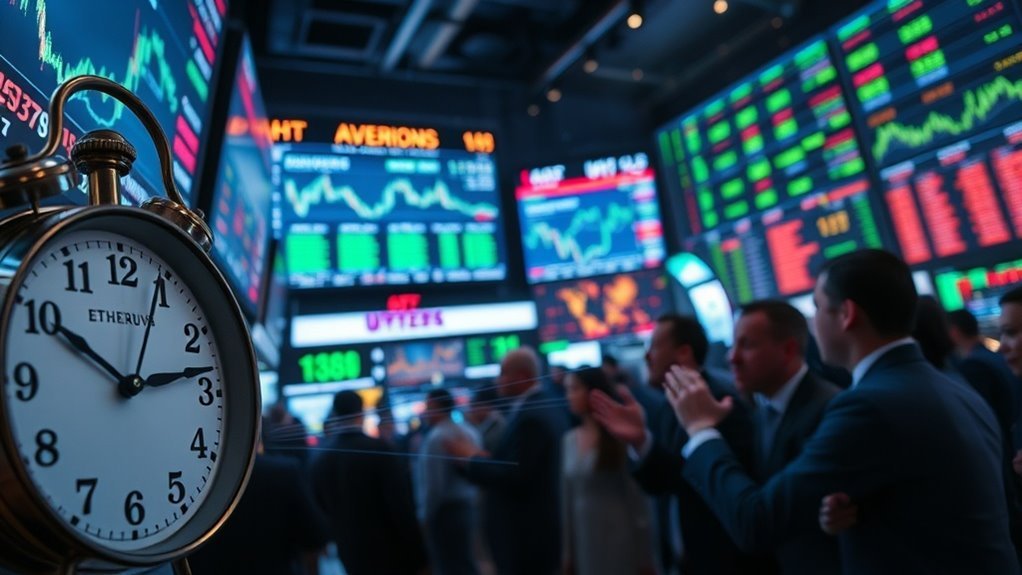
Because block space on Ethereum is finite—each block can hold only ~30 million gas worth of transactions—users bid against each other to secure inclusion. You’re essentially participating in a continuous auction where your gas price determines your position in the queue.
During peak congestion, demand far outpaces available space. Validators prioritize transactions offering the highest gas fees, creating upward price pressure. Your wallet shows a “base fee” (burned) plus a “priority fee” (paid to validators). When network activity spikes—major token launches, market volatility, or popular NFT drops—you’ll see base fees multiply rapidly.
Additionally, the rise of Optimistic Rollups has aimed to alleviate some of this congestion by increasing overall transaction throughput on Ethereum.
You can’t avoid this mechanism entirely, but you can time submissions strategically. During off-peak hours, the fee market settles lower, letting you transact cheaply.
The Mempool: Why Transactions Queue and Fees Spike
The mempool isn’t a single queue. Each validator node maintains its own view of pending transactions, ordered by fee density (gwei per gas unit). During congestion, thousands of transactions compete simultaneously. You’re not just bidding against one other user—you’re competing against everyone posting transactions in that same window.
Mempool dynamics shift rapidly. If you submit a transaction at 50 gwei when the median is 100 gwei, your transaction prioritization drops. Validators naturally select higher-fee transactions first because they capture more MEV (maximal extractable value) and earn larger rewards. Your low-fee transaction gets displaced downward and waits. Higher fees don’t guarantee inclusion—they secure *faster* inclusion during scarcity. This competition for transaction speed is further influenced by the validator role in securing the network and determining priority.
Demand Exceeds Supply: Why Congestion Hits Peak Hours
When you broadcast a transaction during US trading hours or after a major protocol event, you’re competing against thousands of other users for block space that grows at a fixed rate—roughly 12 seconds per block, with a hard cap of ~30 million gas per block. This inelastic supply meets surging transaction urgency during market volatility, liquidations, or NFT drops. Network dynamics dictate that validators prioritize transactions offering the highest gas price, pushing base fees upward as the mempool swells. You’re not waiting longer because the network slowed—you’re waiting because demand overwhelmed available capacity. Understanding this supply-demand mismatch lets you time transactions strategically or budget gas costs accordingly, rather than panic-bidding against the crowd. The recent Ethereum 20 upgrade significantly enhances transaction throughput, which could alleviate some congestion during peak periods.
How Gas Prices Rise During Network Congestion

As demand for block space intensifies, Ethereum’s fee mechanism responds algorithmically rather than through manual adjustment—and you’ll see that response play out in real time across your wallet or block explorer. The dynamic fee structure automatically raises the base fee per unit of gas when blocks fill up, creating a natural price discovery mechanism. Validators prioritize transactions offering the highest tips, pushing your own transaction down the queue if you don’t match or exceed what others are willing to pay. This transaction prioritization system means you’re competing directly against other users for limited block space. During peak congestion—major market moves, NFT drops, or protocol changes—that competition drives gas costs exponentially higher. You control your own speed by adjusting your tip, but you cannot escape the base fee increase itself. Understanding economic incentives within Ethereum can help users navigate these fluctuating costs more effectively.
Reduce Costs Now: Practical Tactics for Peak Times
Understanding that base fees and tip competition drive costs upward doesn’t mean you’re stuck paying peak prices—you’ve got several levers to pull right now.
Your cost saving strategies start with timing: batch transactions during low-congestion windows (typically early morning UTC) when base fees drop. Use Layer 2 solutions like Arbitrum or Optimism—they inherit Ethereum’s security while slashing costs by 90% through blob storage introduced at Dencun.
For transaction prioritization on mainnet, set a competitive but reasonable tip rather than overpaying. Tools like Etherscan’s gas tracker show real-time priority levels. Consider bundling multiple interactions into a single transaction when possible, reducing calldata overhead.
If your transaction isn’t time-sensitive, enable mempool monitoring and execute when congestion clears. These tactical adjustments keep you financially safe while maintaining network participation. Additionally, understanding the transition to PoS can provide insights into how network changes may influence gas fees in the future.
Real-World Examples: When Fees Hit Extremes
Peak congestion episodes reveal why fee management matters beyond theory. You’ve likely witnessed extreme fee spikes during major market events or NFT launches. Real-time tracking tools show gas prices spiking from 50 gwei to 500+ gwei within minutes.
Historical trends expose patterns worth monitoring:
- NFT drops: Pudgy Penguins mint drove fees above 3,000 gwei in 2022.
- DeFi liquidations: Market crashes trigger cascading transactions, pushing fees to 2,000+ gwei.
- Exchange outages: When centralized platforms halt withdrawals, on-chain volume surges.
- Token launches: High-demand airdrops concentrate transactions in single blocks.
- MEV extraction: Sandwich attacks bundle transactions, consuming block space aggressively.
You can mitigate exposure by using Layer 2 networks or batching transactions during quieter hours (2–6 AM UTC typically sees 30–40% lower fees). Real-time dashboards like Etherscan’s gas tracker provide actionable data for timing your moves strategically. Additionally, understanding the reduced 51% attack risks in PoS can provide insights into the overall stability of the network during high-demand periods.
Why Layer 2 Offers Permanent Relief Over Mainnet

While mainnet congestion remains structural—a product of finite block space and network-wide demand—Layer 2 solutions sidestep the problem entirely through a different architecture. On Arbitrum, Optimism, Base, and zkSync, you post transactions to a rollup sequencer rather than competing for mainnet block inclusion. That sequencer batches thousands of your transactions into a single compressed blob, then settles it on Ethereum mainnet at a fraction of the cost per transaction.
Your transaction efficiency improves dramatically because you’re no longer paying for individual mainnet block space. Instead, you split the mainnet settlement cost across thousands of users. Proto-danksharding (EIP-4844) made this even cheaper by introducing blob storage, further reducing Layer 2 fee structures. This scalability solution isn’t temporary relief—it’s permanent architectural relief, making mainnet gas spikes irrelevant to your Layer 2 activity.
Frequently Asked Questions
Can I Set Gas Fees to Zero, or Does Ethereum Require a Minimum Amount?
You can’t set gas fees to zero—Ethereum requires a minimum gas requirement for every transaction. You’ll set a base fee plus a priority tip, ensuring your transaction’s safely processed by validators on the network.
Why Do Some Transactions Fail Even After I Paid High Gas Fees?
High gas fees don’t guarantee success—you’ll fail if your transaction gets evicted during network congestion, reverts on-chain, or gets frontrun. Gas covers computational costs, not transaction prioritization or reliability. You’re paying for execution, not certainty.
How Do Validators Prioritize Transactions if Multiple Ones Offer the Same Gas Price?
When you submit transactions with identical gas prices, validators prioritize based on arrival time and mempool ordering. Your fee estimation matters—higher priority fees increase your chances of selection ahead of equally-priced competitors.
Does Using a Hardware Wallet Change How Gas Fees Are Calculated or Applied?
Your hardware wallet doesn’t change gas fee calculation—fees depend on network demand and your chosen gas price. However, you’ll gain transaction security benefits and hardware wallet protection that safeguard your funds during submission.
What Happens to Unspent Gas if My Transaction Completes Faster Than Estimated?
You’ll get a refund for unused gas. When your transaction completes faster than your gas estimation predicted, the EVM burns only what you actually consumed. You’re refunded the difference at the transaction’s gas price—you don’t overpay for speed.
Summarizing
You’ve now seen how finite block space creates an auction for your transactions. When demand spikes, you’re competing against thousands of other users, and you’ll pay more to get included. Understanding this mechanic lets you strategically time submissions during quieter periods or embrace Layer 2 solutions for consistent, affordable fees. Congestion isn’t permanent—it’s solvable through scalability.

